Shop Vac CFM, Not Suction, Picks Up Sawdust
· 15 min read
As an Amazon Associate we earn from qualifying purchases. We compare manufacturer specs against what buyers report from their own garages. Links here may earn us a commission; no manufacturer has ever seen a draft.
Airflow is the spec, suction is nearly noise
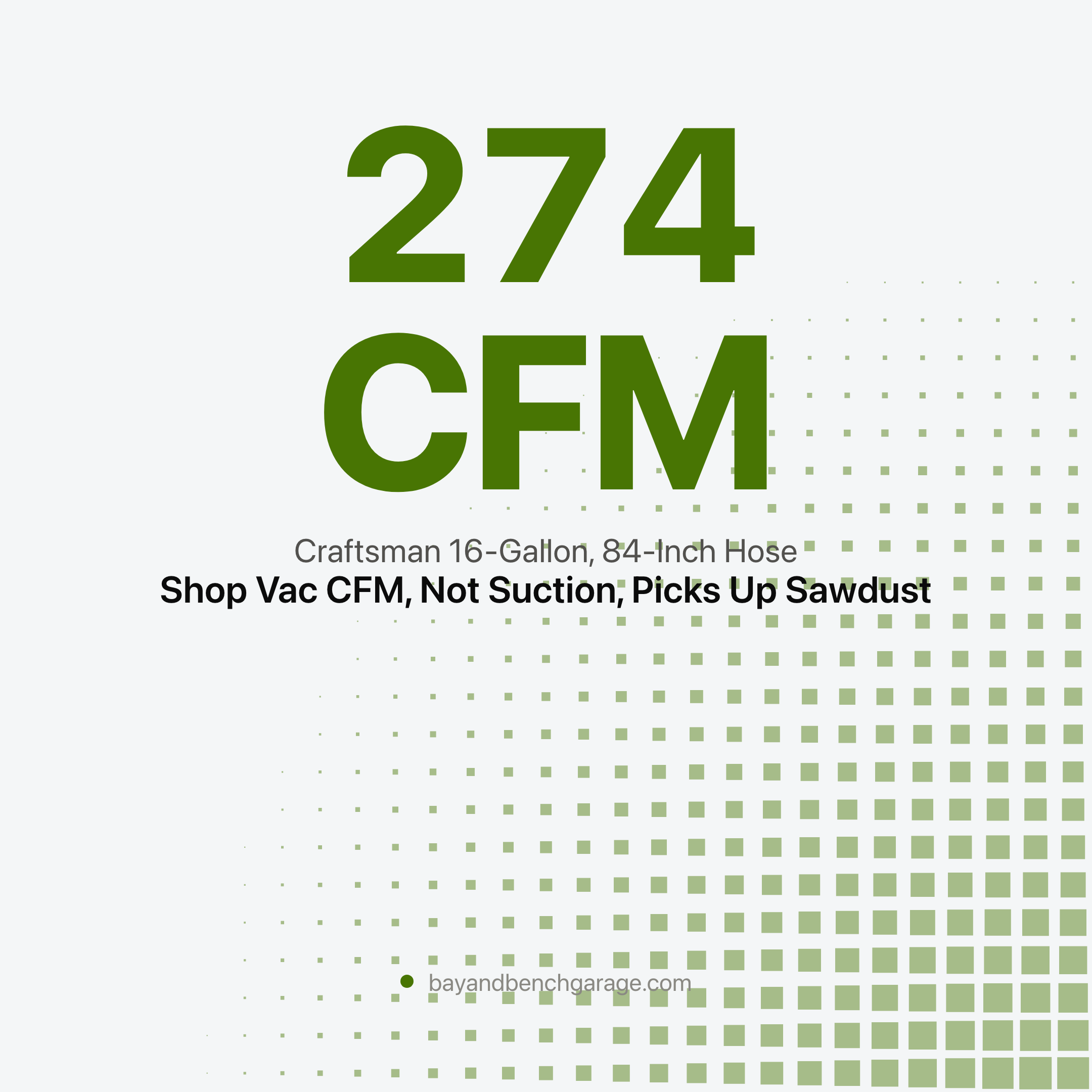
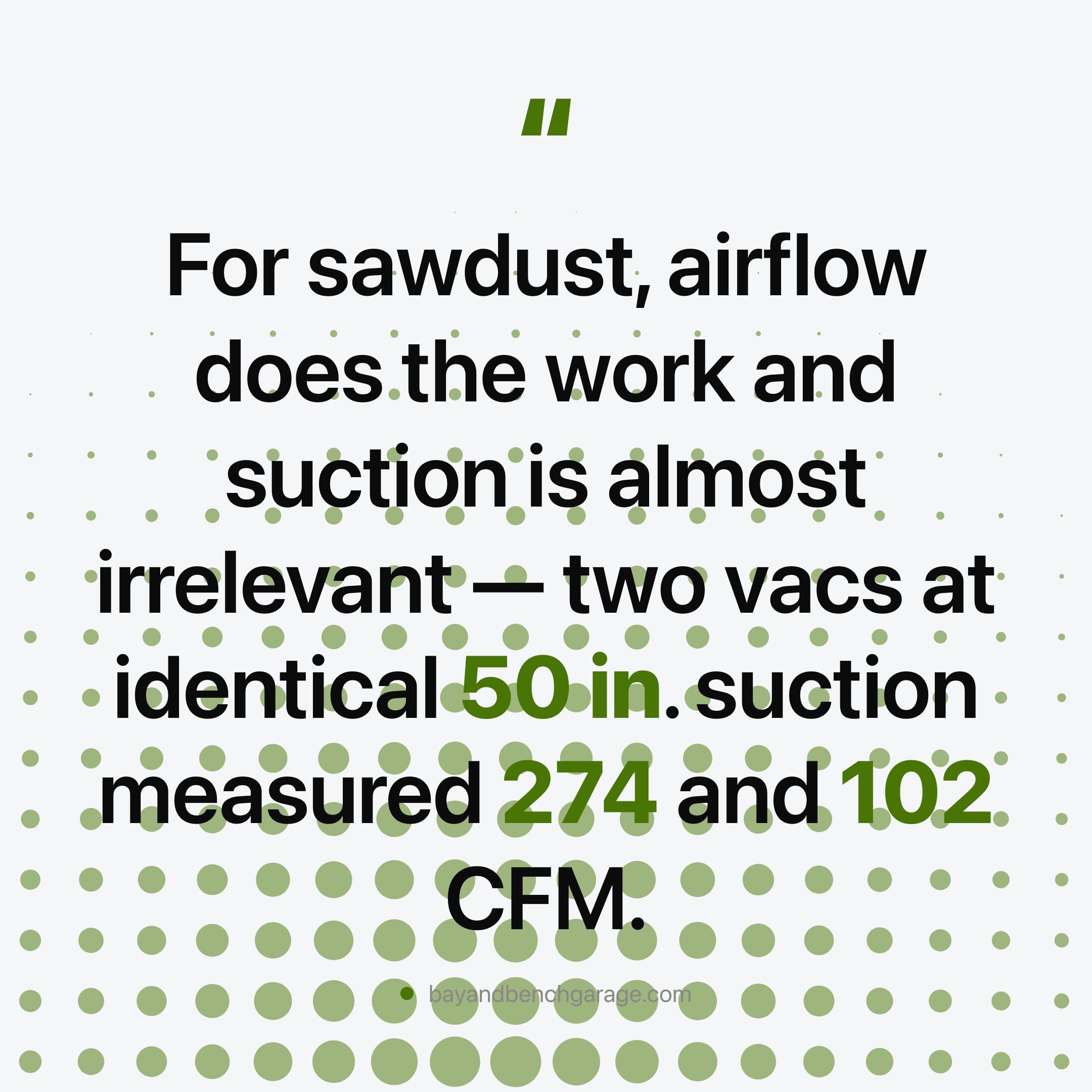
Two vacs on TechGearLab's bench pulled exactly the same suction: 50 inches of water. One moved 274 CFM, the other 102. That spread at identical suction is the whole argument about shop vac cfm in one measurement, and it is why the number on the side of the box tells you almost nothing about how fast a pile of sawdust disappears.
The 274 CFM figure belongs to the Craftsman 16-gallon canister, tested with an 84-inch hose. The 102 came from the Stanley 6-gallon. Same suction reading, wildly different air movement. Suction pressure is what lifts water out of a bucket and drags packed grit from a groove. Airflow is what carries loose, light, bulky debris up a hose — and sawdust is loose, light and bulky.
If you are buying a vac to sit next to a mitre saw or a sander, this is the decision the rest of the specifications hang on. Airflow governs pickup rate; suction governs how hard it pulls against a restriction. Get those two straight and tank size, hose diameter and filter choice fall into place. Get them confused and you buy a 6.5 peak HP drum that clogs on offcuts.
One benchmark settles the obvious follow-up question. Vacuum Wars measured an average of 197 CFM at the hose across five 6.5 peak HP wet/dry vacs, against an 83 CFM average it has measured at the hose on upright vacuums — more than double, on its figures.
| Product | Capacity | Item Weight | Filter Type | Form Factor | Best for |
|---|---|---|---|---|---|
| Vacmaster VJE1412SW0201 | 14 gallons | 28 pounds | Foam | Cannister | Best stated airflow |
| Shop-Vac 12 | 12 gallons | 10.8 kg | Cartridge | Cannister | Best blower output |
| CRAFTSMAN CMXEVBE17595 | 16 gallons | 26 pounds | Cartridge | Cannister | Best large capacity |
| Vacmaster Blue | 12 gallons | — | Cartridge | Handheld | Best detachable blower |
| Vacmaster Professional | 14 gallons | 28.4 pounds | Cartridge | Upright | Best fine-dust filtration |
| Shop-Vac 8 | 8 gallons | — | Cartridge | Cannister | Best mid-size garage |
| Shop-Vac 5 | 5 gallons | 6.55 kg | Foam | Cannister | Best compact workshop |
| Stanley - SL18116P | 6 gallons | 13.4 pounds | Foam | Cannister | Best suction lift |
| CRAFTSMAN CMXEVBE18595 | 16 gallons | 26 pounds | Cartridge | Cannister | Best jobsite hauling |
| Amazon Basics | 4 gallons | 4.56 kg | Cloth | Cannister | Best lightweight pickup |
| Shop-Vac 1.5 | 1.5 gallons | 3.08 kg | Cloth | Handheld | Best wall-mounted |
| Armor All AA255W 2.5 | 2.5 gallons | 11 pounds | Cloth | Cannister | Best vehicle interiors |
Specifications as the listings give them. “Best for” is our assessment, not a manufacturer claim.
The answer, first
- The pick: CRAFTSMAN CMXEVBE17595, for it is the right answer for a long renovation or shop cleanup where you would rather empty a 16-gallon drum once than a small tank six times.
- Also worth it: Vacmaster VJE1412SW0201, for it is the right answer when you want a published airflow figure to size against, because it states 123 CFM and 83 in. of water lift outright instead of leaving you with a peak-HP number.
- How this was decided: published specifications and buyer reports across 12 products, compared below.
The four things to compare, and the two to ignore
Four specifications decide whether a vac moves sawdust. Two more get printed in large type and tell you nothing.
Compare these:
- Published airflow in CFM — the only figure that reflects real restriction from filters and bags rather than a theoretical maximum, which is why This Old House treats CFM as the best metric for comparing similar machines. Most listings state no airflow figure at all.
- Hose diameter — 2-1/2 in. versus 1-1/4 in. is the difference between carrying shavings and bridging on them.
- Filter type — a cartridge holds fine dust, foam is a wet filter.
- Tank volume against how long you work — 1.5 gallons empties four times in a sanding session, 16 gallons empties once in a renovation.
Ignore these:
- Peak HP. Vacuum Wars tested five vacs all badged 6.5 peak HP and measured maximum suction of 46, 55, 57, 59 and 88 inches of water with a 7 ft hose, a 20 ft cord and 2.5-inch attachments held constant across every one of them, so the variance sits in the motor and housing rather than the accessories. Ripclean says published horsepower is usually peak or theoretical rather than sustained or measured under working conditions.
- Composite "Power Score" rankings. Vacuum Wars builds its score by adding maximum airflow to maximum suction, but suction moved only from 46 to 88, and Vacuum Wars notes the total scores were driven by airflow, so the ranking is largely an airflow ranking. Correct for sawdust. Misleading for wet pickup, where suction is what lifts the water.
The same four criteria apply to every vac below, in the same order. Sizing the circuit that runs the vac and the saw together is a separate decision.
Twelve vacs on the same four attributes
Four attributes decide this.
Capacity, published airflow, hose diameter and filter type. Everything else on a spec sheet is either a peak-HP figure that means nothing at the nozzle or a convenience feature.
Read the airflow column first, and notice how few entries it has. Published airflow figures are scarce: many listings give peak HP and leave you guessing.
Now read the hose column against it. This Old House states plainly that a 2-1/2 in. hose improves dust and chip collection on larger vacs, and a LumberJocks forum contributor puts it more bluntly: reducing a shop vac down to a standard 1-1/4 in. hose for hand tools degrades performance significantly.
This Old House puts fine-dust pleated paper at 99 percent capture from 10 microns down to 1 micron; foam is a wet-pickup filter that happens to be fitted. For sawdust that distinction matters more than three gallons either way.
Small tanks: wall-hung, carried, and bench-side
Small tanks fail on sawdust for a reason that has nothing to do with power. Sawdust is bulky and light: a drum fills by volume long before it fills by weight, so a 1.5-gallon or 2.5-gallon body reaches full during a single sanding session while the motor is still barely loaded. Volume runs out first. Every time.
The Stanley illustrates the inversion running through this lineup. TechGearLab, testing a 6-gallon Stanley, found the narrow hose clogged repeatedly at the hose opening because large debris could not pass, which is the same failure mode a 1-1/4 in. hose produces on shavings and offcuts.
What the small units are actually for
TechGearLab's measurements on comparable small units point the same way: the Shark MessMaster's 1.5 in. hose struggled on bark and gravel despite high measured suction, and the Dirt Devil 5-Gallon's small hose diameter limited bulky debris while its tall narrow body, small base and top-mounted storage made it prone to tipping.
If the constraint is genuinely space rather than debris volume, a wall-mounted vac is the honest choice — it stores on a bracket beside the bench and never competes for shelf depth you have already sized to your totes.
Find your case
- Least capacity: Shop-Vac 1.5 at 1.5 gallons.
- The middle of the range: Shop-Vac 12 at 12 gallons.
- Most capacity: CRAFTSMAN CMXEVBE18595 at 16 gallons, worth it for it is the right answer when the same 16-gallon drum is wanted in the tougher-duty trim for jobsite knocking about rather than tidy home use.
Eight to sixteen gallons: what the extra volume actually buys
Stepping from 8 gallons to 16 buys you emptying frequency and nothing else. Airflow, suction and filtration do not scale with tank volume, and the badge on the front tells you less than you would expect. Vacuum Wars measured five vacuums all rated 6.5 peak HP and got suction figures of 55, 57, 88, 59 and 46 inches of water — the Craftsman CMXEVBE17595, Ridgid NXT, Vacmaster VJE1412SW0201, Vacmaster VJH1612PF0201 and Workshop WS1600VA in that order.
The important part is what was held constant. Hose length, cord and 2.5-inch fittings were the same across all five, so the variance sits in the motor and housing rather than the accessories. Peak HP is not a performance figure. It is a marketing figure.
Read composite scores as airflow scores
Vacuum Wars ranks these machines on a Power Score that combines airflow and suction: the Craftsman CMXEVBE17595 led at 303, the Ridgid 16 Gallon followed at 276, the Vacmaster Beast at 250. Look at the inputs. Suction across the group spanned 46 to 88 inH2O, a range of 42; while Vacuum Wars reports the total scores were driven by airflow. A sum dominated by one term is a ranking of that term. So the Power Score is an airflow ranking in disguise, which makes it the right ranking for sawdust and the wrong one for standing water.
The trade-offs are physical, not spec-sheet. TechGearLab found the Craftsman 16-Gallon's plastic thinner than other models' and its casters hard to install, and measured it at 96 dB. Vacuum Wars noted that the two-large-rear-wheel machines, including the Vacmaster Beast, did not follow testers around as easily as the four-caster units. If pulling the hose drags the tank, buy the casters.
Why the number on the box is not the number at the nozzle
The Fein Turbo I is listed at 150 CFM. Fein's own manual gives 72 CFM once a 4-metre hose is attached — less than half the headline figure, from the same document. Nothing broke. The two numbers simply measure different things.
Rated CFM is a bare-inlet figure: no hose, clean filter, empty tank. Woodworking Talk contributors note that advertised airflow is measured at the vacuum with nothing connected, which describes a condition no one ever works in. This Old House goes further and states that some manufacturers deliberately measure at the hose connection to publish a higher number. So any published CFM figure is better read as the ceiling than the working figure.
Then the filter starts filling. Fine sawdust is the worst case here, because it packs into the pleats instead of sitting in the tank. The Carbide 3D forum reports that without a cyclone separator a filter can clog in about five minutes, and that while the vac keeps running its efficiency is greatly reduced. That is the failure mode people misdiagnose as weak suction. The vac is fine. The filter is the restriction.
A cyclone separator ahead of the vac fixes this, and it is worth being precise about how. It does not add airflow. It drops the bulk of the chips and much of the fine dust into a bucket before they ever reach the pleats, so the filter stays cleaner for longer. Some users on that same forum remove the vac filter entirely behind a cyclone and vent the exhaust outdoors, trading fine-dust capture for flow.
Two consequences. Buy above 90 CFM rated, per This Old House's stated threshold — though the source does not say whether that figure refers to a no-hose or at-hose measurement. And budget for the separator, not just the vac.
Can a shop vac replace a dust collector on a planer?
Rockler's Dust Right tool-activated HEPA extractor is rated at 85 CFM. Festool's Cleantec CT 15 E is rated 130 CFM with 96 inches of static pressure. Both are purpose-built dust extractors, and both are rated below the airflow figures Vacuum Wars measured at the hose on 6.5 peak HP wet/dry vacs — though no source establishes that the two sets of numbers were measured the same way. That inversion tells you what these machines are for: pressure at a small port, not volume at a wide one.
Vacuum Wars measured an average of 197 CFM at the hose across five 6.5 peak HP wet/dry vacs, against an 83 CFM average at the hose on the upright vacuums it has tested. So the answer to "can I just use the house vacuum" is no, by a factor of more than two.
No tool-side CFM requirements appear in any of the sources consulted, so the airflow a stationary planer or jointer actually needs cannot be stated here.
The split is a pressure-versus-volume one. Dust collectors run around 2–15 inches of water column at high volume; shop vacs and extractors run 20–150 inches at low volume. The LumberJocks discussion holds that on small tools with small dust ports high pressure matters more than CFM, while CFM matters more on large machines.
Use a shop vac for hand tools, tool ports and floor cleanup. Feed a planer with a dust collector.
Vacmaster VJE1412SW0201 — Best stated airflow
- Publishes the numbers the sizing question actually turns on: 123 CFM, 83 in. water lift, 380 air watts
- Stainless steel tank on a cart, so the 14-gallon body rolls rather than tips when the hose is pulled
- But: 14 gallons of steel plus cart is a footprint, not a thing you tuck under a bench
- But: Foam filter is listed as the filter type, so fine-dust capture depends on fitting the cartridge
Shop-Vac 12 — Best blower output
- Converts to a 145 CFM blower, well above the 55–70 CFM conversions on the small units
- 12-gallon stainless tank with a large built-in drain port for liquids
- But: Hose is only 1-1/4 in., which restricts airflow and clogs faster on shavings and offcuts than a 2-1/2 in. hose
- But: 80 db means hearing protection for extended work
CRAFTSMAN CMXEVBE17595 — Best large capacity
- 16 gallons is the largest tank in this group
- 2-1/2 in. Dual-Flex hose with 180-degree movement at both ends resists kinking, which protects airflow
- But: 46 in. maximum suction is well below the 83–85 in. figures on smaller units
- But: No CFM figure published, only 6.5 peak HP
Vacmaster Blue — Best detachable blower
- Blower detaches with a one-hand release and operates on its own
- Publishes 106 CFM airflow and 210 MPH blowing speed
- But: No water lift figure published, so deep-pile or clogged pickup performance is unstated
- But: Indoor/outdoor usage listed as indoor only
Vacmaster Professional — Best fine-dust filtration
- High-efficiency cartridge filter rated to capture particles down to 1 micron
- Five dust collection bags included among 18 accessories, so fine dust leaves in a bag
- But: No CFM or water lift figure published for this variant
- But: 14-gallon stainless tank and cart is a permanent parking spot
Shop-Vac 8 — Best mid-size garage
- 8-gallon tank sits between the tidy 5-gallon units and the 12–16 gallon drums
- Over 19 ft of cleaning reach from a 12 ft cord and 7 ft hose
- But: 1-1/4 in. hose is the narrow standard and will bridge on wood offcuts
- But: Only two wheels, so it drags rather than rolls freely
Shop-Vac 5 — Best compact workshop
- 5-gallon stainless tank resists dents and rust better than moulded plastic
- Four casters plus a collapsible top handle for carrying and stowing
- But: Only 13 ft of cleaning reach, held back by a 6 ft cord
- But: Foam filter as listed suits wet work more than fine sawdust
Stanley - SL18116P — Best suction lift
- 85 in. maximum suction, the highest figure in this group
- 6-gallon tank keeps it portable while still holding a session's worth of debris
- But: 80 db and no CFM figure published, so airflow is unknown
- But: Foam filter is aimed at wet pickup, not fine dust
CRAFTSMAN CMXEVBE18595 — Best jobsite hauling
- 16-gallon capacity with onboard storage for hose, cord and nozzles
- 2-1/2 in. Dual-Flex hose flexes 180 degrees at both ends against kinking
- But: 72 db, louder than the sibling 16-gallon model
- But: 46 in. maximum suction and no published CFM
Amazon Basics — Best lightweight pickup
- Around 4.56 kg, the lightest tanked unit listed here
- Stainless steel tank despite the small 4-gallon size
- But: 4 gallons fills quickly during any real sanding session
- But: No CFM, water lift or hose diameter published
Shop-Vac 1.5 — Best wall-mounted
- Wall bracket and tool holder included, so it stores off the floor entirely
- Collapsible handle and 1.5-gallon body for grabbing one-handed
- But: 1.5 gallons means frequent emptying during any sanding work
- But: Only a 4 ft hose, so the unit must be unhooked and moved constantly
Armor All AA255W 2.5 — Best vehicle interiors
- 2.5-gallon polypropylene tank with a wheel base and top carry handle
- 48 in. maximum suction published, respectable for the size
- But: Cloth filter rather than a fine-dust cartridge
- But: 2 peak HP and no CFM figure published
Where to stop, by shop
For sawdust, tank volume runs out before weight does: a drum of bulky dry shavings fills to the rim long before it approaches the load it handles as a wet vac. Choose the tank against how long you work between emptyings, not against the wet rating.
Bench-only work, or a car interior, is the case for a small carried or wall-hung unit. With a cyclone separator ahead of the vac, the drum below catches the shavings and the vac tank stays nearly empty, which reduces the value of extra capacity.
Vacuum Wars scored the Craftsman CMXEVBE17595 at 303 on Power Score against 250 for the Vacmaster Beast, listing them at $149.99 and $499.99, and found no real difference in filtration across all five 6.5 HP machines it tested, despite some advertising better filters. The 274 CFM that opened this piece came from a 16-gallon Craftsman on TechGearLab's bench — a different tester and a different measurement from Vacuum Wars' Power Score. Buy the airflow, and treat the 16-gallon Craftsman as the default. The figure nobody publishes is CFM at the nozzle with a full tank — until a manufacturer states it, an 84-inch hose test is the closest you get.
The verdict
CRAFTSMAN CMXEVBE17595, best for it is the right answer for a long renovation or shop cleanup where you would rather empty a 16-gallon drum once than a small tank six times.
Not the right answer for everyone:
- For it is the right answer when you want a published airflow figure to size against, because it states 123 CFM and 83 in. of water lift outright instead of leaving you with a peak-HP number: Vacmaster VJE1412SW0201.
- For it is the right answer when the vac has to double as your dust mover on a big cleanup, because it converts to a 145 CFM blower — the highest blowing figure listed here: Shop-Vac 12.
- For it is the right answer if you want the blower to come off in your hand and be used away from the tank, rather than aiming a whole 12-gallon canister: Vacmaster Blue.
Before you order the CRAFTSMAN CMXEVBE17595: 46 in. maximum suction is well below the 83–85 in. figures on smaller units
Questions
What's a good CFM for a shop vac for sawdust?
This Old House suggests buying above 90 rated CFM, though it doesn't state whether that's measured at the bare inlet or the hose. Tested machines land higher: Vacuum Wars measured an average 197 CFM at the hose across five 6.5 peak HP wet/dry vacs, and TechGearLab measured 274 CFM on a 16-gallon Craftsman.
Is CFM or suction more important for collecting sawdust?
CFM. Sawdust is loose, light and bulky, so airflow carries it up the hose; suction only matters when pulling against a restriction, like lifting water or packed grit. Two vacs on TechGearLab's bench read identical 50 inches of suction yet moved 274 and 102 CFM respectively.
Why do two shop vacs with the same 6.5 peak HP rating perform differently?
Peak HP is a marketing figure, not a performance measurement. Vacuum Wars tested five vacs all badged 6.5 peak HP with hose length, cord and 2.5-inch fittings held constant, and measured maximum suction of 46, 55, 57, 59 and 88 inches of water. The variance sits in the motor and housing.
Does a bigger gallon tank mean more CFM?
No. Airflow, suction and filtration don't scale with tank volume. Going from 8 to 16 gallons buys you fewer trips to the bin and nothing else. Because sawdust is bulky and light, a drum fills by volume long before weight, so size the tank against how long you work between emptyings.
Can a shop vac replace a dust collector on a table saw or planer?
Not on large stationary machines. Shop vacs run 20–150 inches of water column at low volume; dust collectors run roughly 2–15 inches at high volume. Use a shop vac for hand tools, small dust ports and cleanup, and feed a planer or jointer with a dust collector.
How much CFM do you lose with a hose, and does a HEPA filter cut airflow?
A lot. The Fein Turbo I is listed at 150 CFM but Fein's own manual gives 72 CFM with a 4-metre hose attached. Rated CFM is a bare-inlet figure with a clean filter and empty tank. Fine sawdust packs filter pleats — one forum reports clogging in about five minutes without a cyclone separator.
Sources
- Best Shop Vacs of 2026 | Lab Tested & Ranked accessed 2026-08-04
- Best Shop Vac: 6.5 HP Wet/Dry Models Tested | Vacuum Wars accessed 2026-08-04
- Dust extractors, shop vacs, and CFM ratings | LumberJocks Woodworking Forum accessed 2026-08-04
- Best shop vac vacuums which one would you pick? - CNC Machines - Carbide 3D Community Site accessed 2026-08-04
- Important Specs With Shop Vac? | Woodworking Talk accessed 2026-08-04
- CFM vs. HP: What Actually Determines Shop Vac Suction Power? accessed 2026-08-04
- CFM vs. HP: What Actually Determines Shop Vac Suction Power? accessed 2026-08-04
- How to Select and Use Shop Vacuums - This Old House Skip to content accessed 2026-08-04