Garage Shelf Depth: Sizing Shelves to Your Totes
· 12 min read
As an Amazon Associate we earn from qualifying purchases. We compare manufacturer specs against what buyers report from their own garages. Links here may earn us a commission; no manufacturer has ever seen a draft.
Measure the rim, not the base
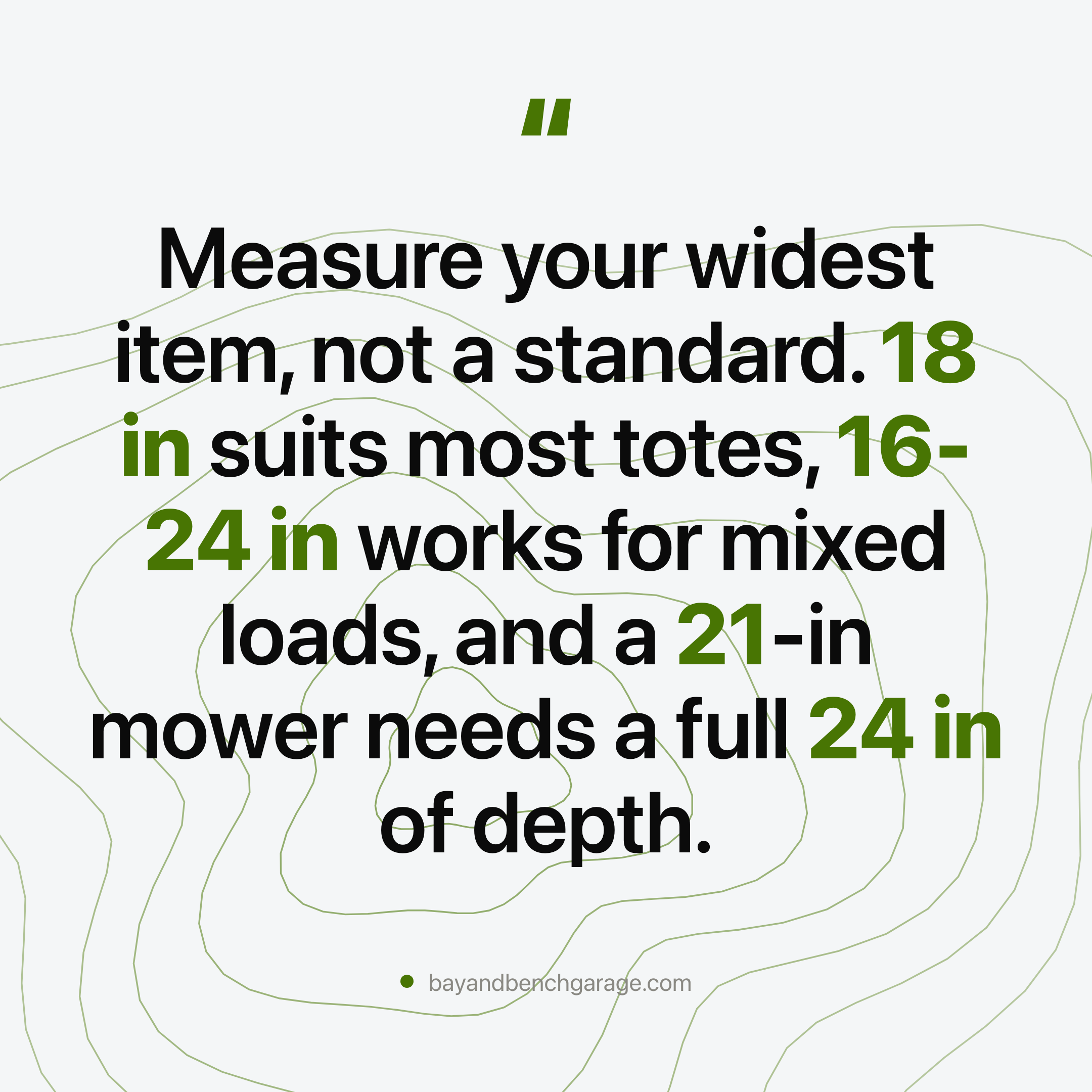
No source consulted here publishes the footprint of a standard tote, a 5-gallon bucket or a cooler, so the container dimensions that would let you check a shelf depth against the object in your hand are not available. What can be said is that depth has to be derived from the largest single item, not the average one: Your Best Digs notes that a 21-inch lawn mower will not sit on an 18-inch shelf, which forces the 24-inch version.
Measure your own containers at their widest point, both directions, then pick a depth that covers the largest one you actually intend to shelve. Everything after this depends on getting that single figure right: overhang tolerance, reach limits, corridor width.
Published ranges do not agree. Your Best Digs calls 18 inches the most common garage shelf depth; Bay Garage puts the workable band at 16 to 24 inches; SpaceManager Closets starts at 18 and goes to 24; Steel Power Shelving declines to name a best figure and lists 12, 16, 20 and 24 as the standard options. Gladiator's own buying guide sidesteps the argument: measure the items and the space, including obstacles, before choosing.
| Product | Product Dimensions | Material | Item Weight | Number of Shelves | Best for |
|---|---|---|---|---|---|
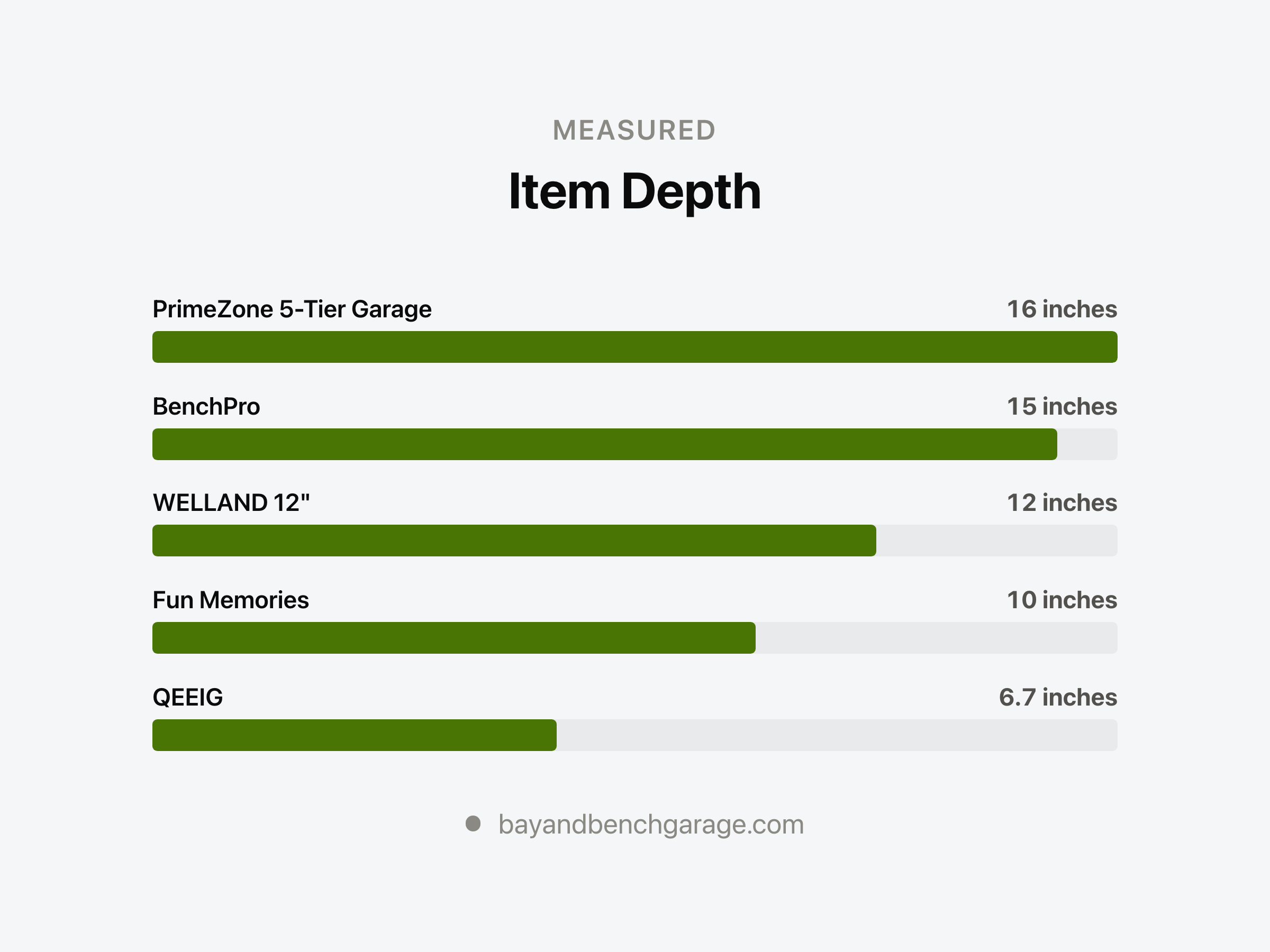
| PrimeZone 5-Tier Garage | 16"D x 32"W x 63"H | Engineered Wood, Metal | — | 5 | Best garage tote rack |
| BenchPro | 15"D x 36"W x 1"H | Wood | — | 1 | Best deep wall shelf |
| WELLAND 12" | 35.43" x 11.81" x 2" | Engineered Wood | 7.5 pounds | 1 | Best low-profile depth |
| Fun Memories | 10"D x 24"W x 6"H | FSC-Certified Wood | 4.33 kg | 2 | Best bracketed pair |
| Axeman Picture Ledge | 4.13"D x 36"W x 2"H | Engineered Wood | — | 3 | Best lipped ledge |
| QEEIG | 17.68 x 8.31 x 5.67 inches | FSC-Certified Wood Board | 5 pounds | 3 | Best compact set |
Specifications as the listings give them. “Best for” is our assessment, not a manufacturer claim.
The answer, first
- The pick: PrimeZone 5-Tier Garage, for it is the only unit here that is actually a freestanding garage shelving rack, so it is the right answer when the question is whether a 16-inch-deep bay will take a storage tote.
- Also worth it: BenchPro, for it is the deepest wall-mounted option here at 15", so it suits someone who wants a single shelf that can genuinely carry a bin or crate off the floor.
- How this was decided: published specifications and buyer reports across 6 products, compared below.
Depth, capacity, mounting
The units in this group range from one floor rack down to five wall boards of decreasing depth. Note that none of the depth or capacity figures for these six products appears in the sources consulted here.
So what separates them, if not depth? Mount type sets the ceiling on how much depth is usable, and stated capacity tells you whether the depth is for the container or only its contents. Note that Reibii warns buyers to check whether an advertised load rating is per tier or for the whole rack, since brands lead with the bigger figure; Reibii puts common market phrasing at 600 lbs per tier and 2500 or 3000 lbs total.
Which depth for which shelf?
For reference points outside the garage, SpaceManager Closets gives book shelves as generally 10 to 12 inches deep, shallow enough that nothing gets lost at the back; closet shelves as typically 12 to 16 inches; and pantry shelves as often 12 to 18 inches, keeping containers visible. The specifications of the individual wall shelves compared here are not covered by the sources consulted.
Support beats depth
None of the sources consulted here covers dimensional lumber widths, sheet-goods yields or saw kerf, so no build arithmetic can be given.
Support matters more than the arithmetic. Your Best Digs notes that half a rated load placed mid-span on an unsupported chip-board shelf will bow or break, Only the Gladiator among the boltless clip-together units tested shipped with a centre support bracket, though the review notes aftermarket supports are sometimes available; the reviewers' top pick, the Gladiator Heavy Duty Rack, uses 48-by-18-inch shelves with centre bracing. Depth without mid-span support is depth you cannot load.
How much can a tote hang over the edge?
No source consulted here states how far a loaded container may project past a shelf edge, or how far a rated load can cantilever. What the sources do establish is the direction of the risk rather than a threshold.
Steel Power Shelving argues that deeper shelves need more robust construction and should be anchored to the wall, because depth increases tipping risk; it gives no threshold at which anchoring becomes mandatory. And put the heavy items low, 16 to 24 inches off the ground, which is where Bay Garage places bins, paint cans and toolboxes anyway.
Find your case
- Least number of shelves: BenchPro at 1.
- The middle of the range: Axeman Picture Ledge at 3.
- Most number of shelves: PrimeZone 5-Tier Garage at 5, worth it for it is the only unit here that is actually a freestanding garage shelving rack.
Reach, and the row you never unpack
Reach is the constraint nobody puts a number on, and none of the sources consulted here supplies one: no source gives an average adult's comfortable forward reach at chest height, which is the figure that would justify any depth ceiling. What the sources do say is qualitative. Steel Power Shelving notes that the deeper the shelf, the harder the back of it is to reach, so things used often argue for going shallower.
Bay Garage puts general-purpose, frequently reached shelving at 48 to 60 inches high, and warns that anything above 6 feet may need a step stool. Bay Garage adds that shelving reaching 84 inches or higher maximises vertical space for rarely used items, and reaching into a deep high shelf compounds the step-stool problem. No source consulted here converts that into a height at which a given depth stops being reachable.
The second row you never unpack
Steel Power Shelving frames the trade-off directly: at 24 inches a shelf holds bulky items and large storage bins but needs deliberate organization to keep things reachable, while at 16 inches it is the versatile middle, taking power tools, bins and boxes, balancing access against capacity. No source consulted here compares the retrievable capacity of two shallow runs against one deep run, and none claims deeper shelves lead to more forgotten items.
Corridor maths
Shelf depth is not the number that decides whether the shelving fits. The corridor is. You have to add the shelf depth to the room needed to stand in front of it and get a loaded bin clear. No source consulted here gives a minimum standing or walking clearance, so the total cannot be computed.
Your Best Digs makes the same point in shorter form: the depth you can afford includes standing room in front of it, not just the footprint.
The same gap applies beside a parked car: no source consulted here states car width plus door swing against the remaining garage depth, so the point cannot be put in numbers.
Steel Power Shelving lists door, window and walking-path clearance as a depth constraint outright, and Your Best Digs makes the same point in shorter form: the depth you can afford includes standing room in front of it, not just the footprint. Measure the swing before the wall.
One deep bay, 16 inches elsewhere
One item should not set the whole run.
A 21-inch mower deck is the classic trap. Your Best Digs points out that a 21-inch mower will not sit on an 18-inch shelf, which forces the 24-inch version, and concludes that depth is decided by the largest single item, not the average one. The risk is that every bay above it then becomes 24 inches deep as well.
One option is a single deep bay: the mower, the compressor or the large toolbox low down, with shallower shelves above. Steel Power Shelving sets 20 inches as the floor for large toolboxes and heavy power tools, and Bay Garage puts heavy or bulky items on low shelves 16 to 24 inches off the ground. No source consulted here addresses whether shelf depth should vary by tier within one unit, or confirms that units are sold with mixed depths, so the construction detail is left open.
Most freestanding racks cannot do this at all. Car and Driver notes that most plastic shelving has little or no adjustability, so you cannot open up a taller bay for an air compressor or miter saw. Depth alone won't accommodate a tall tool. Your Best Digs adds that Amazon Basics wire racks assemble bottom to top in sequence, each shelf slipping over the corner posts, so you cannot pull a single shelf out of the middle later; reconfiguring for a taller item means partial disassembly.
PrimeZone 5-Tier Garage — Best garage tote rack
- 16" depth with a 32" wide bay, so standard totes sit across the shelf rather than overhanging front to back
- Shelves reposition at every 1.2", so a bay can be sized to a tote's height instead of the tote being sized to the shelf
- But: 16" is shallower than the deepest common totes, so larger bins will overhang the front edge
- But: MDF decking is vulnerable to damp and spills, which matters in an unheated or unsealed garage
BenchPro — Best deep wall shelf
- 15" depth is the deepest in this group and close to the 16" bay depth of a floor rack
- 1" thick solid hardwood butcher block rather than engineered board or honeycomb fill
- But: Single shelf only, so multiple purchases are needed for a tiered run
- But: No weight capacity is stated anywhere in the listing, which is the key figure for anything bin-sized
WELLAND 12" — Best low-profile depth
- 11.8" depth, explicitly deeper than the standard 8" and 10" floating shelves
- 2" thickness with MDF plus honeycomb board fill keeps the slab light for its span
- But: 30 lb capacity, so it holds a small bin's contents but not a loaded tote
- But: Honeycomb core cannot be re-drilled or trimmed if the depth needs adjusting
Fun Memories — Best bracketed pair
- 10" depth and 24" width in a set of two, so a staggered or side-by-side run comes in one purchase
- Visible triangular brackets transfer load into the wall rather than relying on a concealed rod
- But: No weight capacity is stated, which is the figure that decides whether a bin can sit on it
- But: 10" is well short of tote depth, so it holds contents rather than the container
Axeman Picture Ledge — Best lipped ledge
- Protected front lip stops items sliding off, unlike every flat shelf here
- Pre-drilled at 16" centres to land on studs, so mounting does not depend on drywall anchors
- But: 4.13" depth is the shallowest usable option here and will not take any bin
- But: 22 lb capacity is the lowest in this group
QEEIG — Best compact set
- 6.7" depth stated as sized for books, baskets and towels rather than ornaments
- Invisible steel brackets with a 2.5° upward angle to resist sagging
- But: 25 lb capacity per shelf rules out anything bin-sized
- But: 6.7" depth is far below tote depth, so it is a contents shelf only
What the units measure
The specifications of the six units this article set out to compare are not covered by the sources consulted here. What is documented is a spread of depths across the market. Car and Driver found wire shelving is generally shallower and narrower than plastic or stamped-metal units, which cuts either way depending on the space available:
- Amazon Basics 4-shelf adjustable: 14.0 in deep, 36.0 in wide, 57.8 in high, 1400 lb total and 350 lb per shelf.
- Seville Classics 5-tier: also 14.0 in deep, 1500 lb total and 300 lb per shelf.
- InterMetro rack: likewise 14.0 in deep, 1200 lb total.
- CX Black & Yellow 4-tier (plastic): 20.0 in deep x 48.0 in wide, 800 lb total and 200 lb per shelf.
- IRIS heavy duty 4-tier (plastic): 17.0 in deep with only 100 lb per shelf.
- Husky 4-shelf (stamped metal): 24.0 inches deep, 2500 lb shelf rating, $249.
Plastic runs deeper than wire, then. Car and Driver notes stamped-metal units can carry five to 10 times the weight of wire or plastic shelving.
Where the capacity claims stop matching
Depth and stated capacity do not track each other reliably across brands. Reibii's 6-tier heavy duty unit goes to 26 inches deep with a stated 3600 lb per unit, while its 5-tier 28-inch-wide unit is only 12 inches deep yet claims 2020 lbs. Its 18-inch-deep 5-shelf wire unit is rated 3200 lbs on feet but only 661 lbs once wheels are fitted. None of these manufacturer capacity claims has been independently verified.
This comparison rests on published specifications and manufacturer listings, not hands-on measurement. Nothing here was loaded, mounted or weighed. Car and Driver tested plastic, wire and stamped metal and updated its roundup in January 2026; Your Best Digs, last updated March 14, 2023, excluded anything over $200 per unit, including industrial pallet racks, so its depth conclusions cover consumer shelving only, and it tested one unit per brand, which limits what its defect findings can say about defect rates. Both leave the same gap: nobody publishes the footprint of the tote you already own. Measure it before you drill.
The verdict
PrimeZone 5-Tier Garage, best for it is the only unit here that is actually a freestanding garage shelving rack, so it is the right answer when the question is whether a 16-inch-deep bay will take a storage tote.
Not the right answer for everyone:
- For it is the deepest wall-mounted option here at 15", so it suits someone who wants a single shelf that can genuinely carry a bin or crate off the floor: BenchPro.
- For it suits a run of wall storage where the shelf itself must stay visually thin, but still needs to be deeper than the usual 8" or 10" board: WELLAND 12".
- For it is the pick when two matching deep shelves are wanted at once and the brackets are allowed to show, since visible triangular supports carry depth better than hidden hardware: Fun Memories.
Before you order the PrimeZone 5-Tier Garage: 16" is shallower than the deepest common totes, so larger bins will overhang the front edge
Questions
How deep should garage shelves be?
Published figures disagree: 18 inches is called the most common depth, 16 to 24 inches the workable band, and 12, 16, 20 and 24 inches the standard options. Rather than pick from the list, measure your largest item at its widest point in both directions and choose a depth that covers it.
Is 18 inches deep enough for a garage shelf?
It depends on your largest item, not the average one. An 18-inch shelf will not hold a 21-inch lawn mower, which forces the 24-inch version. For power tools, bins and boxes, 16 inches is the versatile middle; large toolboxes and heavy power tools want at least 20 inches.
Is one deep shelf better than two shallow ones?
Depth costs access: the deeper the shelf, the harder the back is to reach, so frequently used items argue for shallower. A 24-inch shelf takes bulky bins but needs deliberate organisation to stay reachable. One practical answer is a single deep bay low down for the mower or compressor, with shallower shelves above.
Sources
- How Deep Should Garage Shelves Be? A Comprehensive Guide accessed 2026-08-04
- What Is the Best Height for Garage Shelves? accessed 2026-08-04
- Expert Reviews accessed 2026-08-04
- Beginner’s Guide: How to Choose Industrial Heavy-Duty Garage Shelving – Reibii accessed 2026-08-04
- How Deep Should Shelves Be? - SpaceManager Closets accessed 2026-08-04
- The 5 Best Garage Shelving of 2026 - Reviews by Your Best Digs accessed 2026-08-04
- Shelving Buying Guide | Gladiator accessed 2026-08-04