Garage Outlet Amperage: Two Tools Decide Your Circuit
· 8 min read
As an Amazon Associate we earn from qualifying purchases. We compare manufacturer specs against what buyers report from their own garages. Links here may earn us a commission; no manufacturer has ever seen a draft.
Sizing a Garage Circuit Against Its Continuous Load
The breaker trips mid-cut. Garage outlet amperage should be sized against the load you actually intend to run, rather than assuming the number stamped on the breaker handle is all you need to know. Home Improvement Stack Exchange puts the garage floor at a single 20-amp circuit, and calls 15 amps fine for lighting but limiting the moment tools arrive.
The DIY Home Improvement Forum gives the wattage equivalents as 1800 W on 15 amps and 2400 W on 20 amps.
What follows is a sizing approach, not a shopping list. Work from what will be running at the same time: the evidence collected here consistently points to simultaneity as the deciding factor in whether one 20-amp circuit covers your bay or whether you need two.
The DIY Home Improvement Forum describes the tools that drive the decision in a garage as grinders, drills, a bench grinder, a drill press and similar equipment, and a bathroom fan heater as a typical 1500-watt load. None of the sources consulted give nameplate amperage figures for specific tools, so check your own tools' plates.
| Product | Material | Amperage | Color | Power Plug Type | Best for |
|---|---|---|---|---|---|
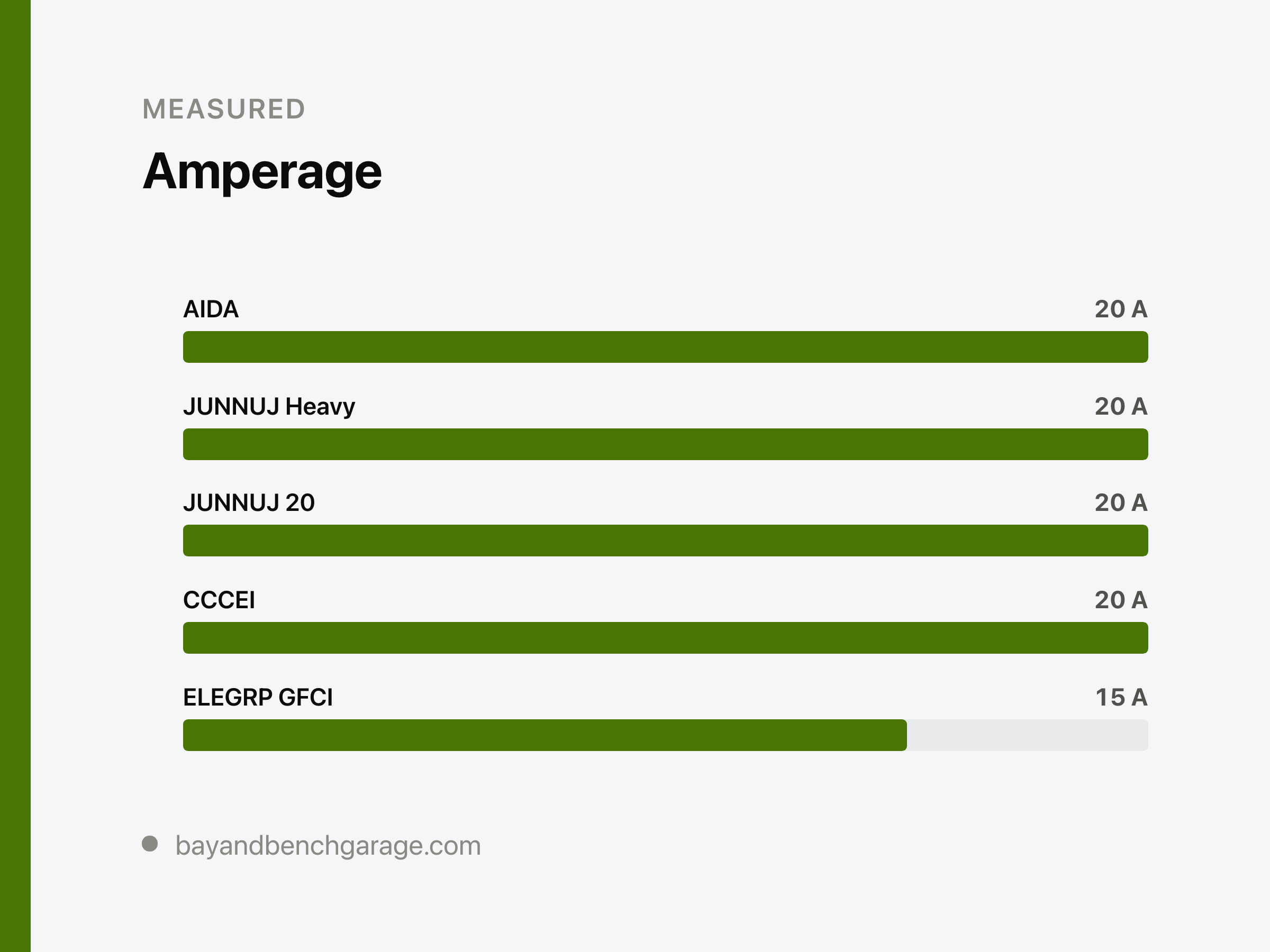
| ELEGRP GFCI | Polycarbonate Thermoplastic | 15 A | Matte White | Type A - 2 pin (North American) | Best GFCI protection |
| AIDA | Polycarbonate (PC) | 20 A | White | Type A - 2 pin (North American) | Best bulk 20A upgrade |
| Amico 100 | Plastic | 15 A | White | Type A - 2 pin (North American) | Best bulk 15A replacement |
| JUNNUJ Heavy | Metal | 20 A | Black | Type B - 3 pin (North American) | Best bench power strip |
| JUNNUJ 20 | Aluminum Alloy Housing and Flame-retardant PC | 20 A | Black | Type B - 3 pin (North American) | Best wall-mounted pair |
| CCCEI | — | 20 A | Yellow | Type B - 3 pin (North American) | Best per-outlet switching |
| Miady | Copper | 15 A | Black | Type A - 2 pin (North American) | Best weatherproof outlet |
| Leviton | Copper | 15 A | Brown | Type A - 2 pin (North American) | Best plain replacement |
Specifications as the listings give them. “Best for” is our assessment, not a manufacturer claim.
The answer, first
- The pick: ELEGRP GFCI, for wiring a code-compliant receptacle on a 15-amp garage branch circuit where ground-fault protection is mandatory.
- Also worth it: AIDA, for rewiring an entire garage or shop to 20-amp receptacles in one pass without buying plates separately.
- How this was decided: published specifications and buyer reports across 8 products, compared below.
Load Pairs That Strain One 20A Circuit
Two heavy tools running at once are what strain a single 20-amp garage circuit, and no receptacle change fixes it. Home Improvement Stack Exchange suggests that where two high-draw tools will run together, a 20-amp multi-wire branch circuit feeding two duplex receptacles in one double-gang box off separate legs lets both run without tripping — though that recommendation comes from a forum poster rather than an inspector or the code text.
What a 20-amp receptacle actually buys
Fuse Service notes that a 20-amp receptacle accepts both plug types, so nothing is locked out either way.
Fuse Service also puts the wiring rule plainly: where both the wiring and the breaker are rated 15 amps, fitting a 20-amp receptacle on that circuit is a code violation, so the receptacle face is the last thing you change, not the first.
Wire gauge, breaker size and the motor problem
The advice to "just run 12 AWG on a 20-amp breaker" is correct as far as it goes. Home Improvement Stack Exchange puts the pairing plainly: 12 gauge copper takes 20 amps, 14 gauge takes 15. DIY Chatroom adds that upsizing to #10 wire buys nothing in a typical garage unless the run exceeds roughly 100 feet.
The fix the sources point to is circuit separation: give a motor that runs alongside other equipment its own circuit.
Thomas Do it Center makes the same distinction by usage: anything running alongside other tools, a dust collector especially, needs a dedicated circuit; a jointer used alone can share.
Check that the breaker matches the wire
Before deciding what receptacle a circuit will take, check that the breaker matches the wire: 14 gauge on 15 amps, 12 gauge on 20, 10 gauge on 30, per the wiring guidance collected on Home Improvement Stack Exchange. None of the sources consulted explain how to verify the gauge behind the wall, so that step may need an electrician.
Find your case
- Least total power outlets: Miady at 1.
- The middle of the range: CCCEI at 4.
- Most total power outlets: AIDA at 20, worth it for rewiring an entire garage or shop to 20-amp receptacles in one pass without buying plates separately.
Long Runs, Detached Garages and When 10 AWG Earns Its Place
Run length is the one thing the sources say changes the wire calculation. The DIY Chatroom consensus puts it plainly: #10 wire buys nothing in a typical garage unless the run exceeds roughly 100 feet.
The splitting rule
Keep lights off the tool circuits entirely. A dedicated 14 AWG 15-amp lighting circuit gives you 1800 W, and DIY Chatroom notes that twelve 150-watt fixtures consume a 15-amp circuit with nothing left over, so a 20-amp lighting circuit carrying sixteen is the step up when fixture count demands it.
Then separate by simultaneity. Thomas Do it Center advises that tools running at the same time as others — a dust collector, for instance — need their own circuit, while machines used rarely and never simultaneously, like a jointer, can share one.
Two More 120V Circuits or a Sub-Panel?
Thomas Do it Center points out that the garage's whole load sits under the house service rating, which for most houses falls between 100 and 200 amps, so the question is not whether one more circuit fits but how many more you intend to add. Each additional home run means another full-length cable pull back to the main panel, and the DIY Chatroom thread on 15A versus 20A garage circuits notes that cable costs far less per foot on 250 to 260 foot rolls than on the 25, 50 and 100 foot rolls sold at big box stores — which only helps if you are pulling enough to justify a whole roll. None of the sources consulted address sub-panel sizing, feeder cable, or 240V garage loads such as welders and EV charging, so the comparison cannot be settled from the evidence available here.
Receptacles and Strips Compared Against the Same Four Criteria
Four criteria separate these eight devices: amperage rating, face configuration (5-15R, 5-20R, 6-20R or flanged), how many receptacles come in the pack, and what protection is built in — ground fault, surge, per-outlet breaker or none. Everything else is finish and colour.
One point first, because it drives wrong purchases. Fuse Service confirms a 20-amp receptacle accepts both 15-amp and 20-amp plugs, so it does not lock out ordinary cords; the same source notes the two faces are told apart by sight, the 20-amp having one slot shaped like a sideways T.
What each step up the range actually buys
The Leviton 15 amps Brown Outlet is one 5-15R device in a brown finish, with copper contacts and no shutters, no ground fault protection and no plate. It matches legacy devices in an older bay. Nothing more.
The ELEGRP GFCI Outlet adds the one thing garage circuits legally require: ground-fault protection at the receptacle. Home Improvement Stack Exchange notes that the required GFCI protection can come from either a GFCI receptacle or a GFCI breaker.
The Amico 100 Pack and the AIDA 20 Pack are quantity plays. Fuse Service is explicit that a 20-amp receptacle installed where both the wiring and the breaker are rated 15 amps is a code violation. If you have resolved that, the AIDA 20-pack rewires a garage in one pass.
The evidence file assembled for this article contains no manufacturer specifications or listing data for these devices, so their configurations and ratings should be checked against the current product listings before purchase.
Which One Suits Your Case
A one-bay garage with a table saw, a shop vac and an overhead light on the same 15-amp circuit is the case the sources warn about, and the remedy they point to is layout before hardware: lights come off the tool circuits entirely, and anything that runs alongside another machine — a dust collector especially — gets its own circuit.
Then match the device to the job. On circuit count, Home Improvement Stack Exchange sets the floor for a garage at a single 20-amp circuit, and DIY Chatroom recommends 12 gauge wire on a 20-amp circuit with at least two outlet circuits and preferably three where power tools will be used. Whichever devices you fit, garage outlets must be GFCI protected.
The verdict
ELEGRP GFCI, best for wiring a code-compliant receptacle on a 15-amp garage branch circuit where ground-fault protection is mandatory.
Not the right answer for everyone:
- For rewiring an entire garage or shop to 20-amp receptacles in one pass without buying plates separately: AIDA.
- For replacing a garage full of aged 15-amp receptacles on existing 14 AWG circuits, at contractor volume: Amico 100.
- For feeding several bench tools from one existing 20-amp garage receptacle with a metal-bodied strip that shrugs off knocks: JUNNUJ Heavy.
Before you order the ELEGRP GFCI: 15 A rating only — cannot serve a 20 A tool circuit needing a 5-20R face
Questions
Should garage outlets be 15 or 20 amp?
Use 20 amp where power tools will run. A 15-amp circuit carries 1800 watts and is fine for lighting, but becomes limiting once tools arrive; a 20-amp circuit carries 2400 watts on 12 gauge copper wire. A 20-amp receptacle also accepts both 15-amp and 20-amp plugs, so nothing is locked out.
Is 20 amps enough for a garage?
One 20-amp circuit is the floor for a garage, not the target. It covers a single heavy tool plus light accessories, but two high-draw machines running together will strain it. Guidance collected here recommends at least two outlet circuits, and preferably three, wherever power tools are used regularly.
How many tools can I run on one 20 amp garage circuit?
Practically one heavy tool at a time. Two motorised tools running simultaneously — a saw plus a dust collector, for example — are what strain a single 20-amp circuit. The fix is circuit separation: give anything that runs alongside other equipment its own circuit rather than changing the receptacle face.
Do garage outlets need to be GFCI protected?
Yes. Garage receptacles must be GFCI protected, and that protection can come from either a GFCI receptacle at the outlet or a GFCI breaker at the panel. Either route satisfies the requirement, so the choice is usually about cost and how many outlets sit downstream on the circuit.
Do I need 10 gauge wire for a garage circuit?
Usually not. Ten gauge wire buys nothing in a typical garage unless the run exceeds roughly 100 feet, where voltage drop starts to matter. Standard pairings are 14 gauge on a 15-amp breaker, 12 gauge on 20 amps and 10 gauge on 30 amps — check the breaker matches the wire.
Sources
- 15 Amp vs 20 Amp Outlet: Key Differences and When to Use Each accessed 2026-08-04
- Garage outlets: 20A or 15A??? | DIY Home Improvement Forum accessed 2026-08-04
- What breaker size and wire gauge should I use for a new garage outlet circuit? - Home Improvement Stack Exchange accessed 2026-08-04
- Garage Outlet 15amp vs 20amp | DIY Home Improvement Forum accessed 2026-08-04
- Guide on Planning Electrical Outlets in Your Garage - Thomas Do it Center accessed 2026-08-04