Garage Ventilation CFM: Sizing a Working Bay
· 14 min read
As an Amazon Associate we earn from qualifying purchases. We compare manufacturer specs against what buyers report from their own garages. Links here may earn us a commission; no manufacturer has ever seen a draft.
The number you need, and the number you buy
You are grinding a bracket with the door shut in February, and the haze is still hanging at head height ten minutes later. That is a garage ventilation cfm problem, and it has an arithmetic answer. A 20 x 22 x 9 ft two-car bay holds 3,960 cubic feet. At 10 air changes per hour, WholeHouseFan's sizing math puts the requirement at 660 CFM. Drop to 6 ACH in a 20 x 20 x 8 ft bay — 3,200 cubic feet — and the figure falls to 320 CFM.
Then buy more than that.
A real garage install puts a backdraft damper, ducting, elbows and a louvered wall cap in the path, and each of those costs flow. No source quantifies the loss: the available sources say only that real-world output depends on attic vent area, intake air and makeup air, not on the fan's rating alone. So a unit sized against the raw ACH number may arrive short before you switch it on.
That gap is what the rest of this article works through: why delivered airflow falls short of the rating, when capturing at the source beats moving the whole room, and why the air path matters as much as the fan.
| Product | Product Dimensions | Material | Item Weight | Electric fan design | Best for |
|---|---|---|---|---|---|
| HG Power 10 | 6.29"D x 11.61"W x 11.61"H | Metal | — | Exhaust Fan | Best wall exhaust |
| Gainsh | 6"D x 12"W x 12"H | Metal | 4.5 pounds | Window Fan | Best for renters |
| MEOZRI | 12"L x 12"W x 5.9"H | Aluminum | — | — | Best speed control |
| ALORAIR 780 | 4"D x 16.1"W x 11.8"H | Stainless Steel | 9 pounds | Exhaust Fan | Best automatic control |
| ALORAIR 540CFM | 15"D x 2.8"W x 10.2"H | Alloy Steel | 6.2 pounds | Exhaust Fan | Best slim opening |
| SABUIDDS 16-Inch | 15.2"D x 16.6"W x 20.5"H | Steel, PVC, Copper, Nylon, Die-cast aluminum, Rubber | — | Blower | Best ducted extraction |
| MOUNTO | — | — | 0.37 kg | — | Best raw volume |
| B-Air VP-25 1/4 HP | 12"D x 12.4"W x 13.3"H | Plastic | 11.3 pounds | Blower | Best daisy-chaining |
| DEWALT 20 | 27.09"D x 10.4"W x 27.28"H | Metal | 18.7 pounds | Floor Fan | Best directional drum |
| Lasko 20" | 7"D x 22"W x 22"H | Alloy Steel, Aluminum, Metal, Rubber | 14.1 pounds | Floor Fan | Best floor-free mount |
| Milwaukee 0886-20 M18 Jobsite | 9.2"D x 9.7"W x 11.3"H | Plastic | 6.8 pounds | Table Fan | Best cordless spot |
| BTMETER BT-100 Handheld Anemometer | 6.5 x 3.34 x 1.49 inches | Plastic | 150 g | — | Best for verifying |
Specifications as the listings give them. “Best for” is our assessment, not a manufacturer claim.
The answer, first
- The pick: HG Power 10, for punching a permanent exhaust point through a garage wall when you want air actually leaving the bay rather than just stirred around.
- Also worth it: Gainsh, for a rented or unmodified garage where the fan has to sit in a window opening now and come out later.
- How this was decided: published specifications and buyer reports across 12 products, compared below.
Free-air rating versus delivered CFM through a real wall
A fan's published CFM figure and what it actually delivers through a garage wall are not the same number. WholeHouseFan states that real-world output of a ceiling exhaust fan depends on existing attic vent area and intake air, not just the fan's rating. How much a fan loses in a given install is not something any of these sources quantifies, and manufacturers here publish no pressure curves, so there is no way to read delivered flow off a listing.
The HG Power 10-inch fan is rated 988 CFM with an integrated backdraft damper, the highest published figure in this group. If you want the flush-mount route with the damper already in the housing, that is the HG Power 10-inch exhaust fan with damper.
Two published cautions bear on this directly. WholeHouseFan states that rated CFM is only reachable with makeup air, so a cracked door is part of the install, not an afterthought. Alan's Factory Outlet puts it more bluntly: a vent's airflow capacity is set by its cross-sectional area, which means an undersized opening caps the fan regardless of what the motor can do.
Where 0.75 CFM/sq ft under-delivers
That figure is not for your garage.
The 0.75 CFM per square foot number that dominates search results for garage ventilation cfm comes from the International Mechanical Code and ASHRAE 62.1, where it applies to enclosed commercial parking decks running continuously during occupied hours. Brucker Co. states the same rate can drop to 0.05 CFM per square foot when a gas detection system is tied in, provided it ramps back to 0.75 on a toxic gas threshold. Brucker Co. discusses it in the context of carbon monoxide in parking decks; the sources do not extend it to welding smoke, solvent vapour or a running engine on a stand.
The mechanical problem is that it is floor-area based. Height does not enter the calculation. A 20 x 20 two-car garage is 400 sq ft, so the code rate gives 400 CFM regardless of whether the ceiling sits at 8 feet or 12. Wholehousefan puts that same garage at 3,200 cubic feet at 8 feet, needing 320 CFM at 6 ACH and 533 CFM at 10 ACH. No source compares the two rates, and none says which figure a residential buyer should use.
Hunter Fan makes the point from the other direction: higher ceilings need higher CFM, and square-footage charts leave that variable out. If your bay has a raised centre section for a lift, or a garage insulation R-value upgrade that pushed the ceiling plane higher, use volume.
Measure the height. Then calculate.
Twelve fans and one meter, on four attributes
Car and Driver's garage fan roundup rated the B-Air VP-25 at 32.8 mph of air speed one foot from the housing on high, falling to 11.1 mph at ten feet. That roundup rated fans by air speed in mph at 1 and 10 feet, not by CFM at all. No source provides a conversion between the two measures.
The table below orders the items cheapest first and puts them on four attributes — rated CFM, exhaust versus circulate, control type and mounting. Read the second column first. It splits the group more sharply than the airflow numbers do.
Three things the table settles quickly. Whether a unit removes air or relocates it. Whether control is a switch, a knob, stepped speeds or a humidistat. And whether the mounting demands a cut opening, a window, a bracket or nothing at all.
What the four columns leave open
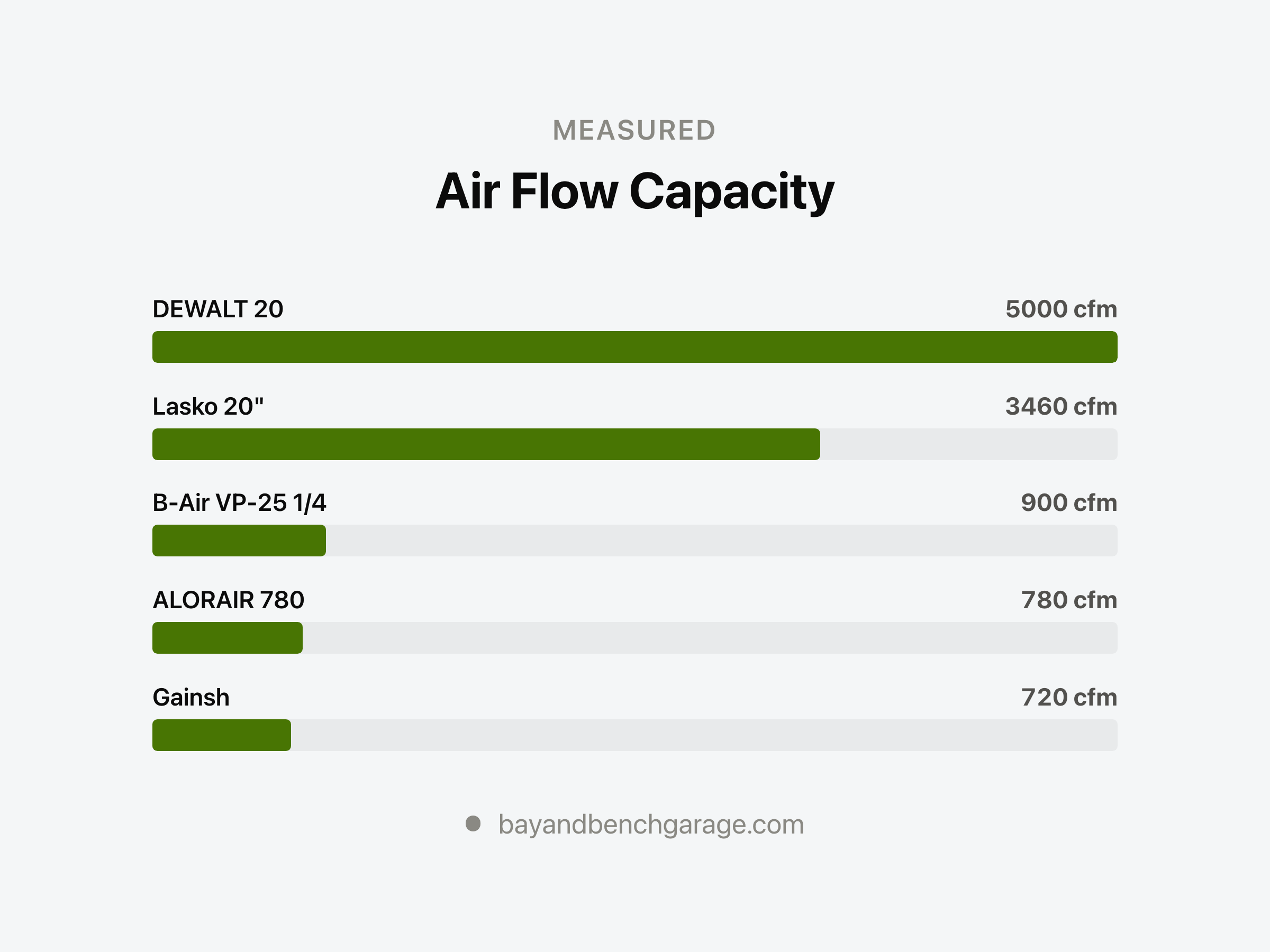
No source in this set states whether a published rating is free-air or how much of it survives an install. Where two units share the same rated CFM, the differences between them — damper, mounting hole size, speed control — do not appear in an airflow column.
The circulate group looks strongest on paper and is weakest on function. Floor and ceiling fans only circulate the air already in the garage rather than exchanging it, and box and pedestal fans vent nothing outside. Portacool states plainly that fans do not cool air; in heat they only help sweat evaporate. Tamarack's own garage exhaust fans are rated 235 and 416 cfm, well under half the HG Power figure, which should make you suspicious of ranking by CFM alone.
Throw, damper, opening size, duty cycle. The table carries none of them.
Find your case
- Least wattage: ALORAIR 540CFM at 58.65 watts.
- The middle of the range: DEWALT 20 at 120 watts.
- Most wattage: SABUIDDS 16-Inch at 1100 watts, worth it for pulling fumes from one specific spot — a running engine or a paint job — out through the garage door.
Exhaust units: which rating survives the install
Several of the units here actually exhaust air outdoors. None of their published ratings survives the install unchanged, since WholeHouseFan notes rated CFM is only achievable with makeup air and that running a ceiling exhaust fan without an open door or window can create negative pressure in the garage. How much airflow it takes to depressurise a garage enough to affect a vented appliance is not something any of these sources quantifies. GreenBuildingAdvisor's discussion of attached-garage ventilation treats a through-the-wall fan rated about 300 CFM at 6 sones as a common candidate for a 24 x 24 x 10 garage, though that thread does not size the fan or say whether 300 CFM is adequate. Brucker Co. puts US carbon monoxide deaths above 450 a year, with more than 50,000 emergency room visits.
So the honest ranking splits.
Whatever unit you choose, WholeHouseFan's guidance is to crack a door or window so the fan is not starved for intake air; no source states how large that opening needs to be for a given CFM. Where combustion appliances and shared doors are not a concern, the HG Power 10-inch is the highest-rated exhaust unit in this group at 988 CFM, with a backdraft damper. The HG Power 10-inch exhaust fan is the flush-mount option here.
Two more caveats. Wall penetrations through an attached garage can violate local fire-separation rules — verify before you cut. And interior-rated fans face humidity and temperature swings they were never built for.
Air movers and drum fans move air; they do not remove it
Car and Driver measured the $260 Mounto Air Mover at 46.9 mph one foot from the outlet, the highest airflow in their test group, and 89.7 dBA on high — the loudest fan tested, at 83.9/87.1/89.7 dBA across its speeds. That is a lot of air moved and nothing exhausted. The garage door was open during their test, on a hot summer day, which is the only condition under which a circulator does ventilation work at all.
Air movers and drum fans relocate the air already in the bay. Floor and ceiling fans only circulate the air already in the garage rather than exchanging it, and box and pedestal fans do not vent anything outside; whatever CFM they are rated at describes throughput past a blade, not air leaving the building. Car and Driver called the MOUNTO potentially overkill for a typical home garage and judged the DeWalt industrial warehouse unit both louder and weaker than a cheaper Lasko floor fan.
What decides whether any of this reaches you

Intake area comes first. Alan's Factory Outlet notes that a vent's airflow capacity is set by its cross-sectional surface area, and WholeHouseFan advises cracking a door or window so the fan is not starved for intake air; no source states the opening size a given CFM requires. Undersize it and the exhaust fan throttles itself.
Then place it. Alan's Factory Outlet puts a garage exhaust fan high on a wall or the ceiling, away from entryways into the home.
Verify rather than assume. Measuring velocity at the vent face and multiplying by the opening area is what turns the ACH math into an observation; a handheld anemometer reads ft/min.
When 100 CFM at the arc beats 1,000 CFM at the wall
Wholehousefan puts welding and chemical work at 15-20 ACH for maximum air turnover, the highest rate on its scale — for a 3,960 cubic foot two-car bay, that is roughly 990 to 1,320 CFM of whole-bay extraction. Whether a source-capture extraction arm can do the same job at lower airflow is not something these sources address.
What the ACH model does cover is the whole room rather than one point: Wholehousefan's scale rises from 4-6 ACH for vehicle storage to 8-10 for regular workshop use, 10-15 for a professional shop or painting, and 15-20 for welding or chemical work. That is the case for a fixed exhaust point sized to the room, and the HG Power 10-inch metal exhaust fan with its backdraft damper is one such unit.
HG Power 10 — Best wall exhaust
- Rated 988 CFM from a 10-inch metal-bodied exhaust fan
- Backdraft damper prevents outside air reversing back into the bay
- But: Single speed only, so airflow can't be dialled down
- But: Rated around 60 dB
Gainsh — Best for renters
- Mounts in either a window or a wall opening
- 720 CFM at 1460 RPM with adjustable speed control
- But: Two speeds only
- But: No damper listed, so backdraft isn't blocked when off
MEOZRI — Best speed control
- Seven aluminium blades in a metal housing, up to 1800 RPM
- Simple knob speed control rather than fixed steps
- But: Listed as inward-exhaust installation, which dictates orientation
- But: 68 watts on a 3-pin 110V cord with no hardwire option
ALORAIR 780 — Best automatic control
- 780 CFM with built-in humidistat and thermostat on an LCD panel
- Freeze protection stops the fan below 37°F
- But: Rated for confined spaces up to about 1,300 sq ft, so a large bay may need two
- But: 6-foot cord limits placement
ALORAIR 540CFM — Best slim opening
- Only 2.8 in deep with a faceplate that can be trimmed for non-standard openings
- 540 CFM with dehumidistat and freeze-protection thermostat
- But: Lowest airflow of the exhaust units here at 540 CFM
- But: Single speed with no manual ramp
SABUIDDS 16-Inch — Best ducted extraction
- Ships with 32.8 ft of PVC ducting to move the intake point to the work
- 1100W copper motor with two speeds
- But: Free-standing rather than a fixed vent, so it occupies floor space
- But: 1100W is a heavy draw on a shared garage circuit
MOUNTO — Best raw volume
- 1 HP rated at 4000+ CFM, the highest figure in this group
- Roto-moulded housing built for commercial and industrial use
- But: 79 dB makes conversation and hearing protection an issue
- But: Moves air within the space rather than exhausting it outdoors
B-Air VP-25 1/4 HP — Best daisy-chaining
- Daisy-chains up to five units from a single outlet
- 900 CFM from 1/4 HP while drawing 2.1 amps on high
- But: 900 CFM is modest for clearing a whole bay alone
- But: 300 watts each once several are chained
DEWALT 20 — Best directional drum
- 5000 CFM at up to 1400 RPM across three speeds
- 180-degree adjustable head for aiming airflow up or down
- But: 27-inch footprint takes real floor space in a working bay
- But: Only a 6-foot power cord
Lasko 20" — Best floor-free mount
- Converts between floor and wall use with the included bracket
- Pivoting head plus remote control from below
- But: No CFM figure published
- But: 20-inch head needs clear wall span and a nearby outlet
Milwaukee 0886-20 M18 Jobsite — Best cordless spot
- 284 CFM from M18 batteries, no cord needed
- Can be wall-hung or set on a bench
- But: 284 CFM is far below any air-change figure for a bay
- But: Battery and charger sold separately in most configurations
BTMETER BT-100 Handheld Anemometer — Best for verifying
- Reads air velocity in m/s, km/h, ft/min, knots and mph within ±2%
- Eight vanes and two temperature sensors, sensitive to low duct velocities
- But: A measuring instrument, not ventilation
- But: Plastic body, AAA powered
Winter: the heat you dump, and where to stop spending
None of these sources addresses what continuous exhaust does to a heated or attached garage's energy use, or whether ventilation should be seasonal — so the heat-loss cost of running a fan sized this way is an open question. What can be said is that WholeHouseFan's sizing figures express a rate of air change per hour, not a duration of running time.
Efficiency matters at this point too. Hunter Fan makes the case for CFM per watt rather than CFM alone, and notes DC and brushless motors cutting draw by more than half at equal airflow. QuietCool quotes its GA ES-1500 at 1452 CFM on about 47 watts, though that fan requires an attic above the garage and will not work with slab ceilings.
For a wall you can cut, the HG Power 988 CFM with its damper is the highest-rated exhaust unit here; for an unattended bay, a humidistat-controlled unit removes the switch from the equation.
The haze at head height was never a fan-size problem alone. Size the fan by volume rather than floor area, and measure the vent with an anemometer before you trust either number.
The verdict
HG Power 10, best for punching a permanent exhaust point through a garage wall when you want air actually leaving the bay rather than just stirred around.
Not the right answer for everyone:
- For a rented or unmodified garage where the fan has to sit in a window opening now and come out later: Gainsh.
- For getting the same 720 CFM through a wall with a knob you can trim to match an odd opening size: MEOZRI.
- For a garage you don't visit daily, where humidity should trigger ventilation on its own: ALORAIR 780.
Before you order the HG Power 10: single speed only, so airflow can't be dialled down
Questions
How many CFM do I need for garage ventilation?
Size by volume, not floor area. A 20 x 22 x 9 ft two-car bay holds 3,960 cubic feet and needs about 660 CFM at 10 air changes per hour. A smaller 20 x 20 x 8 ft bay at 6 ACH needs only 320 CFM. Buy above the calculated figure to cover duct and damper losses.
How much CFM for a 2 car garage?
A 20 x 20 x 8 ft two-car garage holds 3,200 cubic feet, which works out to 320 CFM at 6 air changes per hour and 533 CFM at 10 ACH. The commercial code rate of 0.75 CFM per square foot gives 400 CFM for the same garage, but ignores ceiling height entirely.
Why is my garage exhaust fan moving less air than its rating?
Rated CFM is only achievable with adequate makeup air. A backdraft damper, ducting, elbows and a louvered wall cap all cost flow, and a vent's capacity is capped by its cross-sectional area. Crack a door or window so the fan is not starved for intake air.
What CFM do I need to vent welding fumes?
Welding and chemical work calls for 15-20 air changes per hour, the highest rate on the scale. For a 3,960 cubic foot two-car bay that is roughly 990 to 1,320 CFM of whole-bay extraction. Regular workshop use sits far lower, at 8-10 ACH.
Sources
- Attached garage ventilation - GreenBuildingAdvisor accessed 2026-08-04
- Expert Reviews accessed 2026-08-04
- Garage Exhaust Fan Sizing: How to Choose the Right CFM accessed 2026-08-04
- How To Choose A Garage Fan: 6 Important Tips | Portacool accessed 2026-08-04
- Parking Garage Ventilation – Is Code Ventilation Enough? | Brucker Co. accessed 2026-08-04
- 12 Best Garage Exhaust Fans for 2025: Sizing & Install Tips accessed 2026-08-04
- Garage Ventilation: A Comprehensive Guide (2025 Updated) accessed 2026-08-04
- Choosing the Best Fan for Your Workshop or Garage accessed 2026-08-04