Overhead Garage Storage Rack: 23 Inches Decides Fit
· 12 min read
As an Amazon Associate we earn from qualifying purchases. We compare manufacturer specs against what buyers report from their own garages. Links here may earn us a commission; no manufacturer has ever seen a draft.
Measure the drop before you shop: the clearance formula
Your garage door, when open, does not sit flat against the ceiling. It sits on a track a few inches below it, and the opener rail hangs lower still. That is the number that decides which overhead garage storage rack you can hang, and it is almost never the ceiling height on the listing page.
The formula I use:
usable rack drop = ceiling height − (garage door open-position height + opener rail/track allowance + a service gap). This formula is the writer's own; no source publishes it, and no page addresses how ceiling drop interacts with a sectional door's open-position travel envelope as distinct from the opener rail.
Measure the door's open-position height directly, with the door up. Grease Monkey Garage recommends a tape of at least 16 feet, and taking floor-to-ceiling readings in several spots, then planning against the lowest one.
Worked against Gladiator's 4x8 GearLoft, which the manufacturer gives as 96" L x 48" W with a 23"–37" adjustable height range (the worked figures below are the writer's own arithmetic, not manufacturer or third-party guidance):
- 8 ft ceiling (96"), door open at ~84", rail allowance 4", service gap 2": usable drop is 6". No setting on the 23"–37" range fits under the door path. A 4x8 rack here hangs only at its shortest drop, 23", and only outboard of the door swing, along a side wall or across the rear bay.
- 9 ft ceiling (108"), same door and opener: usable drop is 18", still short of 23". The 4x8 clears only where the track and rail are not overhead.
- 10 ft ceiling (120"), same door and opener: usable drop is 30", so settings from 23" up to 30" are reachable across the door path, and the full 37" remains available outside it.
Two corrections to the common advice. Required clearance is the platform plus whatever sits on it, not the platform alone. And a ceiling-mounted opener makes the centre of the ceiling the worst place to mount anything; a wall-mounted jackshaft opener leaves that bay free.
| Product | Product Dimensions | Material | Item Weight | Additional Features | Best for |
|---|---|---|---|---|---|
| FLEXIMOUNTS 4x8 | 48"D x 96"W x 22"H | Metal | 59.7 pounds | Durable | Best large capacity |
| FLEXIMOUNTS 4x6 | 48"D x 72"W x 40"H | Alloy Steel | 47.8 pounds | Durable | Best joist-spacing fit |
| HyLoft | 45"D x 45"W x 17"H | Alloy Steel | 16 ounces | Adjustable, Durable, Scratch Resistant | Best low clearance |
| KOKORACKER | 48"D x 48"W x 96"H | Metal | — | 4x4 Ft Ceiling Storage Racks | Best ladder-free access |
| GLOBLED | 25.98"D x 2.52"W x 2.72"H | Aluminum | 3.27 kg | Scratch Resistant | Best small footprint |
Specifications as the listings give them. “Best for” is our assessment, not a manufacturer claim.
The answer, first
- The pick: FLEXIMOUNTS 4x8, for the right answer for a two-car garage with a long clear span of ceiling, where you want one big platform sized to swallow bulk seasonal storage in a single mounting job.
- Also worth it: FLEXIMOUNTS 4x6, for the right answer when your ceiling won't take an 8-foot unit but you still want a serious steel platform, and you need something that states exactly what joist spacing it fits before you drill.
- How this was decided: published specifications and buyer reports across 5 products, compared below.
What this comparison is built on
Nothing here was measured.
Every capacity, dimension and clearance figure in this comparison comes from the manufacturer's own listing: the capacity ratings, minimum drops and shelf figures quoted below. I have not hung any of these racks from a joist. What I have done is read the published specifications against each other and against what the numbers imply for a real ceiling.
That distinction matters more than usual. Some widely repeated figures are vendor copy passed hand to hand. The "105 cubic feet reclaimed per unit" claim, for instance, is a vendor-guide figure repeated verbatim across multiple pages rather than an independent measurement, and appears in a January 20, 2026 guide by a single author, May Ann, at Inventive Garage. Fleximounts' own ceiling-height and joist advice is dated 10/23/2024, so it predates the current product lineup.
If your garage is attached and the ceiling is engineered trusses rather than joists, the wrong lag screw goes into a chord whose suitability for suspended loads no manufacturer page addresses. By the end of this you should know which footprint your ceiling can take, and which rated load is honest for the wood you have.
Five racks on ceiling drop, footprint and rated load
Five racks, and per Grease Monkey Garage the four specs that decide fit for a fixed rack: minimum ceiling height, drop distance, footprint, and weight capacity. Everything else on a listing is finish and marketing. A table below carries the specifications for the five racks here, ordered cheapest first, so the ten-second answer sits above the reasoning.
What each step up the range buys is narrower than it looks. The cheapest option is not a rack at all: the cheapest tier is a bracket pair that holds a bin by its rim rather than a deck. It cannot hold a load, only an item.
The next step buys a deck. The useful difference at a given rating is not the number but the format: a fixed deck that starts its drop tight to the ceiling is a different purchase from a lift that brings the platform down to you instead of a ladder. Same rating. Completely different reason to buy.
Where the money actually goes
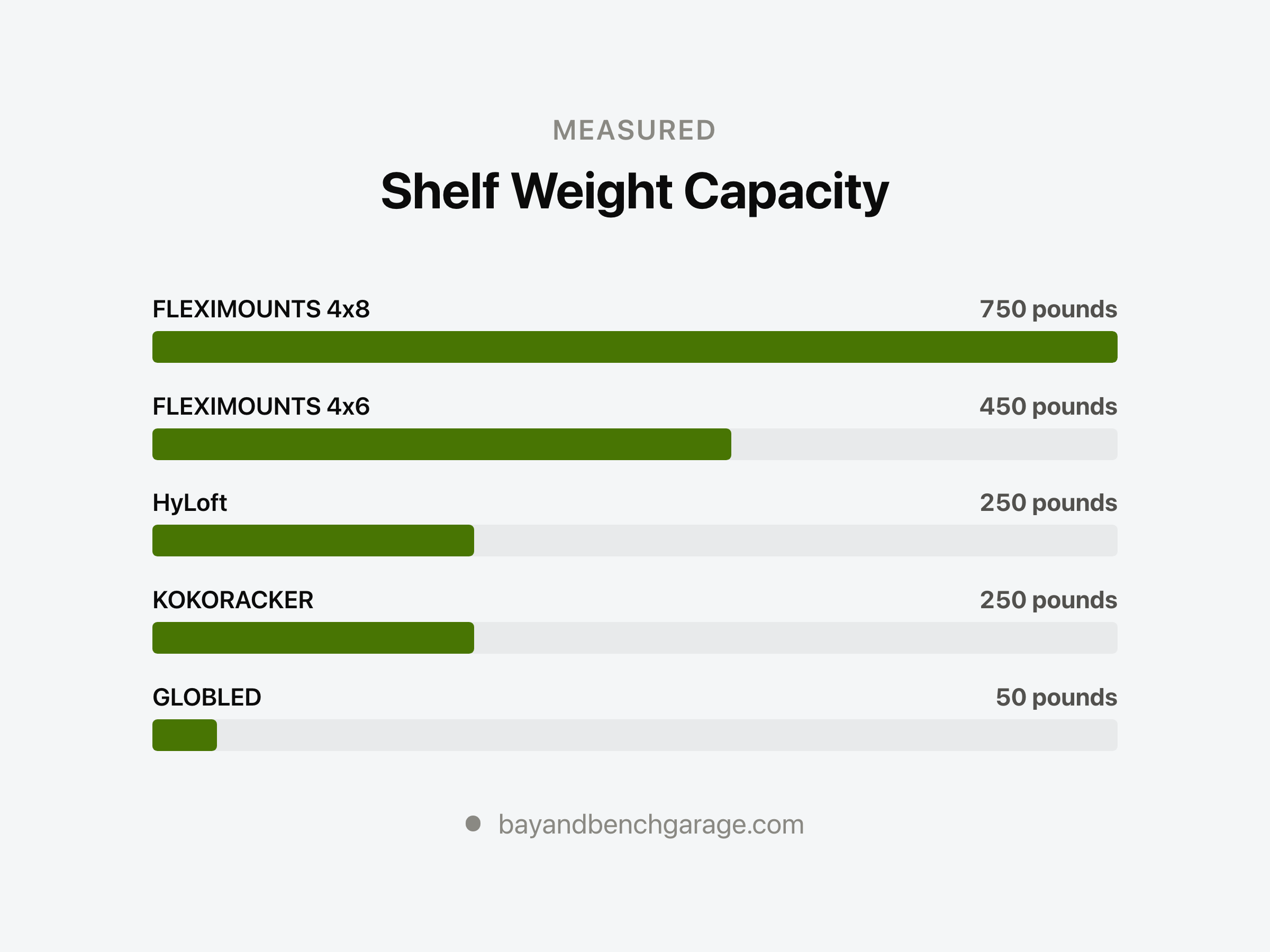
Above 250 lb, you pay for steel and span. Fleximounts rates its GR46 Classic 4' x 6' at up to 450 lb on a cold-rolled steel frame. Its GR48 Classic 4' x 8' ships with an installation template marking exactly where to drill.
For scale on the wider market: Gladiator lists its 4 x 8 GearLoft at $359.99 for 1,000 lb and 96 cu ft, SafeRacks lists a 4 x 8 at $209.99 and MonsterRAX at $199.99, both vendor-stated prices flagged as contested. That is roughly 36 cents per rated pound from Gladiator; the SafeRacks and MonsterRAX capacity ratings are not published on the pages reviewed, so the equivalent figures cannot be computed. At the 4 x 4 tier, SafeRacks shows a contested $94.99 (from $109.99) and MonsterRAX a contested $99.99 (from $129.99), while ONRAX rates select units up to 800 lb on a 14-gauge steel C-channel box frame near $420, about 53 cents per rated pound. There is no independent price history behind any of these 'was' prices. Capacity per dollar improves as you go cheaper. Deck rigidity and bracket count do not.
If your ceiling can only take a small footprint, the smallest Gladiator GearLoft, 24" x 48" at up to 350 lbs, is the one that fits under a low deck without a fight.
Find your case
- Least number of shelves: FLEXIMOUNTS 4x8 at 1.
- The middle of the range: GLOBLED at 2.
- Most number of shelves: FLEXIMOUNTS 4x6 at 5, worth it for the right answer when your ceiling won't take an 8-foot unit.
The rating on the box is a frame rating, not a ceiling rating
Gladiator rates its 4 x 4 ft GearLoft and its 2 x 8 ft GearLoft at the same 500 lb of evenly distributed weight, and both at up to 50 cu. ft. of storage. One has twice the deck area of the other. The number cannot be describing the deck. No page explains how footprint relates to rating, or states the test method behind the 'evenly distributed' figure. Nothing in the published numbers tells you what your ceiling is made of.
That distinction matters because the same rated load arrives at your joists in completely different amounts. A longer rack spans more joists than a shorter one at the same spacing, so the same 500 lb rating arrives as a different load at each mounting point. No page states the fastener count, type or embedment depth behind the rating.
Do the division before you drill
Take the rated capacity, divide by the number of mounting points, and you have the per-point demand at full load:
- Four points under 500 lb is 125 lb each.
- Two brackets under the same 500 lb is 250 lb per point.
- No page states the number of mounting points assumed by any rated capacity, so the divisor is yours to count on the bracket kit.
- No page states what fastener, how many, or what embedment depth achieves the rated capacity, or what to do when a mounting hole lands where no joist runs.
So what is the rating actually rating?
The load path is. Nothing in these sources addresses truss ceilings at all: every mounting instruction assumes joists at 12, 16 or 24 inches, and no page says whether these racks may be mounted to engineered trusses. That is an engineer's question.
If you do not know your rated load in real terms, weigh it. Grease Monkey Garage suggests standing on a bathroom scale holding a loaded tote, subtracting your own weight, then multiplying by the number of totes. No page gives typical weights for a loaded tote, which is why the arithmetic has to be done with your own bins rather than a published figure. The same logic applies to wall-mounted systems: see pegboard vs slatwall load paths and spacing.
Joists running the wrong way, or 24 inches apart
Measure the joists before you order.
Ceiling brackets bolt across joists, not along them, and the rack's width has to land on centers you actually have. Fleximounts states that its GL1 fits 12, 16 or 24-inch spacing and warns that not every garage matches, which is a manufacturer telling you to check first. Here is what to do in each mismatch case.
- Joists run perpendicular to your intended rack orientation: rotating the rack 90 degrees changes which centres the brackets land on, so confirm the door track clears the new footprint before drilling.
- Joists run the wrong way and rotation is blocked by the opener rail: none of these manufacturer pages describes a sanctioned workaround, so this is a question for the manufacturer or an engineer before you drill.
- Spacing is 24 in. o.c. instead of 16 in.: buy a rack that names 24 in. explicitly. Fleximounts states the GL1 fits 12, 16 or 24-inch spacing.
- Rack width falls between joist centers: never shim a bracket onto a single joist edge. Fit blocking between two joists, or use the installation template that ships with the Fleximounts GR48 Classic 4' x 8', which marks exactly where to drill.
- Joists are engineered I-joists or open-web trusses: stop. No page here says whether these racks may be mounted to trusses at all, and every mounting instruction assumes joists at 12, 16 or 24 inches.
The return threshold is simple. If you cannot mount into joists at the spacing the manufacturer names, the rack goes back in the box, whatever the number on the carton says.
"Evenly distributed" and the one-corner safe
Every rating assumes even spread. "Evenly distributed" means the load is spread across the whole deck so each mounting point carries roughly the same share. Gladiator uses this language for its 4x8 GearLoft at 1,000 lbs, and Fleximounts rates its GR46 Classic 4' x 6' at up to 450 lbs. What the phrase means in testing is nowhere defined: no page states the test method, the safety factor, or what happens under an uneven load. None of those figures describe a single object sitting in one corner.
A working rule: divide the rated load by the number of vertical posts, then treat that as your ceiling for any one item. Put a gun safe or a loaded roller tool chest over one corner post and you multiply the design share at that point. No page states what happens under an uneven load, which is how real garages are actually loaded.
The load nobody plans for
Anything you cannot lift overhead in one motion should not go up there at all. That covers safes, engine hoists, dense tool chests, and, as Inventive Garage argues, yard machines and fuels, which belong in a shed.
If the garage is attached
Nothing in these sources covers truss ceilings, fire-separation assemblies, permits, code or insurance implications of suspending several hundred pounds from a garage ceiling. Fleximounts publishes joist-spacing fit guidance: the GL1 fits 12, 16 or 24-inch spacing, and it warns that not all garages match. If the framing is trusses rather than dimensional joists, get an engineer's read.
Which rack suits which ceiling
Match the rack to the number you measured, not to the capacity you wish you had. If your usable drop came out at 23 inches or more and the joists run across a clear span, a full 4x8 is the one worth mounting: Gladiator's 4x8 GearLoft adjusts from 23" to 37" and is rated at 1,000 lbs evenly distributed, with up to 96 cu. ft. of storage, though the Inventive Garage guide puts a 4x8's usable space nearer 105 cu ft, and neither states the stack height assumed. If the drop landed under 23 inches, a smaller footprint such as the 24" x 48" GearLoft at 350 lbs is the fit.
The middle case is the most common one. Joists at 24 inches, a garage door track eating the front third of the bay, and no eight-foot clear run. That is the tier the Fleximounts GR46 Classic 4' x 6' sits in, rated at up to 450 lb on a cold-rolled steel frame. Fleximounts itself warns that garages under nine feet should skip bulkier systems with a lifting range above 79 inches. Stop at this tier. It is where the price step still buys structure rather than mechanism.
Above it, the narrower cases: a lift, if you retrieve the same bins monthly and would rather not use a ladder (Fleximounts cites over 50,000 ladder-fall ER visits a year as the argument), and a shelf-format product such as the Overhead Max GearLoft, 45" W x 16" H x 30" D at up to 200 lbs, when you need a couple of items up and nothing more.
Go measure the door in its open position. That number, not the ceiling, is your shortlist.
The verdict
FLEXIMOUNTS 4x8, best for the right answer for a two-car garage with a long clear span of ceiling, where you want one big platform sized to swallow bulk seasonal storage in a single mounting job.
Not the right answer for everyone:
- For the right answer when your ceiling won't take an 8-foot unit but you still want a serious steel platform, and you need something that states exactly what joist spacing it fits before you drill: FLEXIMOUNTS 4x6.
- For the right answer for a low-ceiling garage where every inch of clearance matters and you need the platform to sit as tight to the deck as possible: HyLoft.
- For the right answer if you don't want to climb a ladder every time you retrieve something, because the platform itself comes down to you: KOKORACKER.
Before you order the FLEXIMOUNTS 4x8: full 4 ft depth needs clear ceiling and can crowd a garage door track or opener
Questions
How much ceiling clearance do I need for a 4x8 overhead garage storage rack?
Work from usable drop, not ceiling height: ceiling height minus the door's open-position height, the opener rail allowance and a service gap. An 8 ft ceiling with the door open at 84 inches leaves roughly 6 inches. A rack with a 23–37 inch drop range needs about 10 ft, or mounting outboard of the door path.
How much space is there between an open garage door and the ceiling?
Less than people assume. The door sits on a track a few inches below the ceiling and the opener rail hangs lower still, so on an 8 ft ceiling the door can top out near 84 inches. Measure it directly with the door up, in several spots, and plan against the lowest reading.
What if my garage ceiling joists are 24 inches apart or run the wrong way?
Buy a rack that names 24 in. on-center explicitly; Fleximounts states its GL1 fits 12, 16 or 24-inch spacing. If joists run across your intended orientation, rotate the rack 90 degrees and recheck door-track clearance. If the opener rail blocks rotation, ask the manufacturer or an engineer before drilling.
How much weight can my garage ceiling joists actually hold?
No manufacturer page answers that, because the rating on the box describes the steel frame, not your ceiling. Divide the rated capacity by the number of mounting points to get per-point demand: 500 lb over four points is 125 lb each; over two brackets it is 250 lb. Wood species, fastener type and embedment decide the rest.
Can you mount an overhead storage rack to roof trusses?
None of the manufacturer pages reviewed says trusses are permitted. Every mounting instruction assumes dimensional joists at 12, 16 or 24 inches on center. Engineered I-joists and open-web trusses carry roof loads through specific chords, so suspending several hundred pounds from them is a question for an engineer, not a listing page.
Are overhead garage storage racks safe if you load one corner?
Every published rating assumes an evenly distributed load, with no page defining the test method or safety factor. A working rule is to divide rated load by the number of vertical posts and treat that as the ceiling for any single item. Keep safes, engine hoists and dense tool chests off overhead racks entirely.
Sources
- High-Quality Steel Storage Racks for Your Garage - SafeRacks accessed 2026-08-03
- Best Overhead Garage Storage in 2026: 7 Smart Systems Compared accessed 2026-08-03
- MonsterRax Overhead Garage Storage Racks | Veteran Owned – MonsterRAX accessed 2026-08-03
- Best Overhead Garage Storage in 2026: 7 Smart Systems Compared accessed 2026-08-03
- How to Measure for Overhead Garage Storage – Grease Monkey Garage accessed 2026-08-03
- Garage Overhead Storage Buying Guide | Gladiator accessed 2026-08-03
- How to Pick the Overhead Garage Storage that Works for You | FLEXIMOUNTS accessed 2026-08-03
- Best Overhead Garage Storage in 2026: 7 Smart Systems Compared accessed 2026-08-03