Garage Storage Cabinets Vary More by Steel Gauge Than Material
· 11 min read
As an Amazon Associate we earn from qualifying purchases. We compare manufacturer specs against what buyers report from their own garages. Links here may earn us a commission; no manufacturer has ever seen a draft.
All nine cabinets at a glance
Material dictates everything. Steel garage storage cabinets carry the highest loads. Resin resists moisture without maintenance. Engineered wood belongs only where the cabinet sits in plain sight.
Nine options here span from 28-inch wall-mount boxes to 72-inch freestanding lockers. The comparison below covers each on five attributes: footprint, shelf count, adjustability, total weight capacity, and mount type. Some bolt to studs. Others stand on legs or roll on casters. Your wall framing and floor space will eliminate options before preferences do.
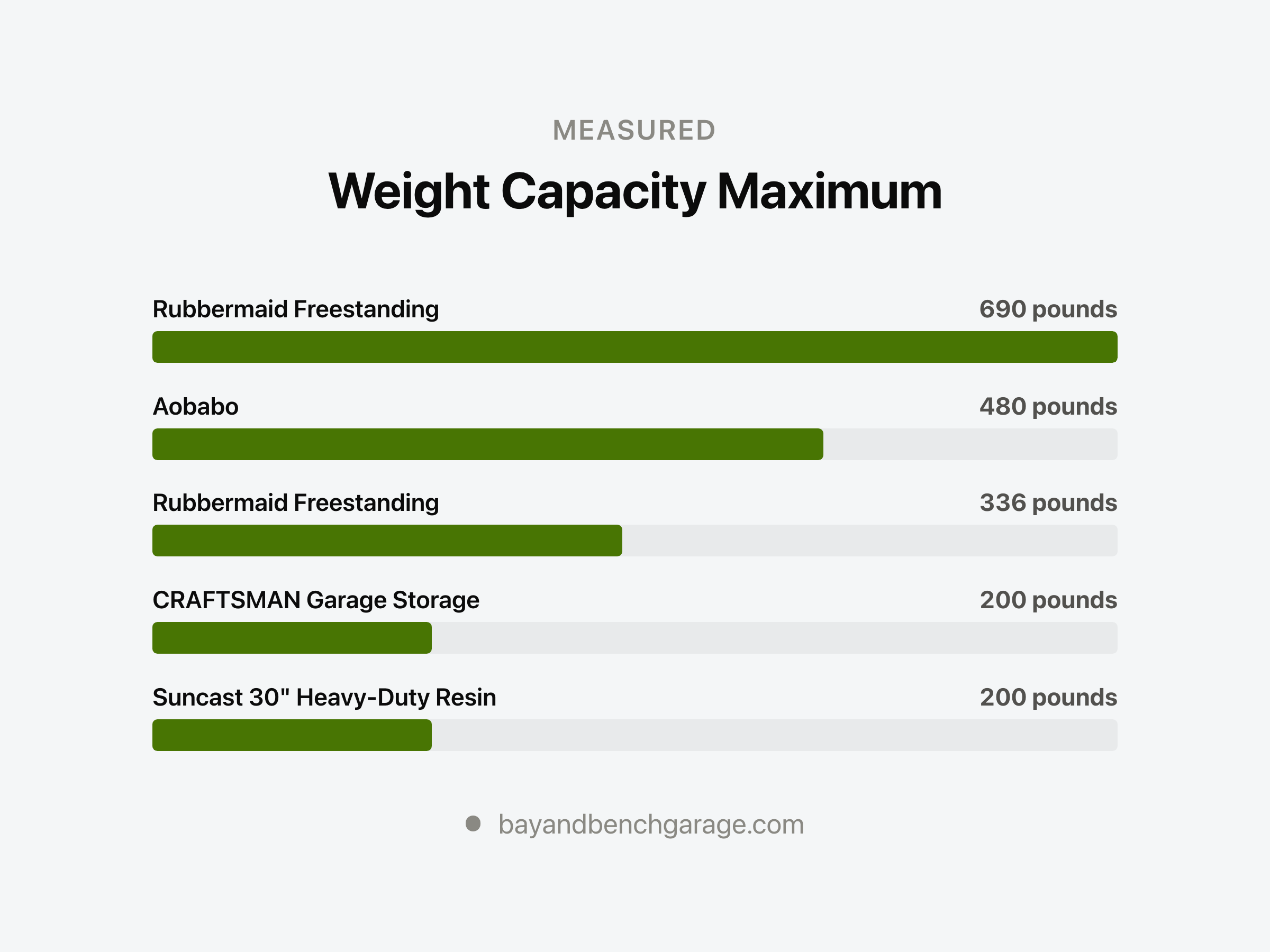
Capacities tell the sharpest story. The Majnesvon full-height steel cabinet tops the group at 900 lbs across four adjustable shelves. The full-height Rubbermaid resin locker holds 690 lbs, but none of its four shelves adjust.
Among wall-mounts, Car and Driver confirmed the Craftsman holds 200 lbs total at 100 lbs per shelf, versus the identically sized Gladiator at 40 lbs per shelf. Same 12 × 28 × 28-inch box, different load rating. Shelf adjustability splits the field almost evenly: five cabinets let you reposition shelves, four lock them in place at the factory.
This guide works from published specifications for steel and resin cabinets alongside one engineered-wood sideboard. No cabinet was physically tested for this piece. You get every load rating, dimension, and climate constraint in one view, so the wrong material gets ruled out before you start comparing brands.
The basis for this list: published product information and manufacturer figures only. Nothing here was measured or used in person.
| Product | Product Dimensions | Material | Item Weight | Number Of Shelves | Best for |
|---|---|---|---|---|---|
| Gladiator Ready-to-Assemble Full-Door | 12"D x 28"W x 28"H | Alloy Steel | 27.2 pounds | 2 | Best for modular wall systems |
| CRAFTSMAN Garage Storage | 31.63"D x 14.25"W x 7.5"H | Alloy Steel | 34 pounds | 1 | Best USA-made wall cabinet |
| Suncast 30" Heavy-Duty Resin | 20.25"D x 30"W x 36"H | Resin | 42.7 pounds | 2 | Best compact lockable resin |
| Rubbermaid Freestanding | 7.09 x 14.17 x 14.57 inches | Polyethylene (PE), Resin | 28.3 pounds | 2 | Best tool-free assembly |
| Rubbermaid Freestanding | 18"D x 36"W x 72"H | Resin | 68 pounds | 4 | Best full-height resin |
| Aobabo | 16"D x 32"W x 71"H | Metal | — | 5 | Best for tool organization |
| Majnesvon | 18"D x 36"W x 72"H | Alloy Steel | 85.8 pounds | 4 | Best heavy-duty steel |
| Manhattan Comfort Fortress Textured | 18.2"D x 30.3"W x 31.5"H | Metal | 51.4 pounds | 2 | Best mobile workstation |
| SONGMICS Storage Cabinet | 15.7"D x 31.5"W x 29.9"H | Alloy Steel, Engineered Wood | 42.1 pounds | 3 | Best for living spaces |
Specifications as the listings give them. “Best for” is our assessment, not a manufacturer claim.
The answer, first
- The pick: Majnesvon, for garages storing heavy automotive parts, stacked tool chests, or bulk hardware where total weight capacity is the primary concern.
- Also worth it: Gladiator Ready-to-Assemble Full-Door, for garages already using or planning the Gladiator Wall System, where the hanger-bracket mount lets the cabinet slide into position and reposition along the track without drilling new holes.
- How this was decided: published specifications and buyer reports across 9 products, compared below.
How do steel, resin, and engineered wood actually differ?
Material dictates where a garage cabinet can live and what it can hold. Steel, resin, and engineered wood overlap in size but diverge on load capacity and moisture tolerance.
Per-shelf capacity varies more within steel than across materials
Steel per-shelf ratings in this group span from 40 lbs on the Gladiator wall-mount to 180 lbs on the Majnesvon full-height cabinet, a range wide enough that "steel" alone tells you nothing about what a shelf will bear. Manhattan Comfort is the only listing in this group that specifies steel thickness: 24-gauge. Without that spec from other manufacturers, the stated load rating is the main available indicator of panel thickness.
Resin closes the gap. Suncast's multi-wall reinforced resin panels hold 200 lbs per shelf, higher than every steel wall-mount here. Rubbermaid's full-height five-shelf cabinet carries 690 lbs total across four shelves.
The SONGMICS cabinet pairs an alloy steel frame with engineered wood panels. No panel grade is specified in the listing. The panels are not moisture-proof.
Climate tolerance
Steel depends on its finish for corrosion resistance. Every steel cabinet here uses powder coat or textured paint, but no manufacturer in this group publishes coating-durability or damage-resistance specs. Resin is immune to rust, rot, and peeling per both Rubbermaid and Suncast listings. Engineered wood sits at the opposite end: stable in a conditioned space, unreliable in a damp or unheated garage. If your garage lacks climate control, garage heater BTU sizing determines whether wood-panel furniture belongs there at all.
What dimensions does your layout need to follow?
Garage cabinets follow the same dimensional grid as kitchen cabinetry. Plan your layout around these fixed numbers before choosing a brand or material.
Heights
- 34.5 inches for base cabinets. Add a 1.5-inch countertop and the working surface lands at 36–38 inches.
- 12 to 42 inches for wall cabinets (available in 12, 15, 18, 30, 36, and 42). Most garage layouts use 30- or 36-inch wall units.
- 84 or 96 inches for tall cabinets. A 96-inch unit needs a full 8-foot ceiling with no overhead obstruction.
Depths
- 24 inches for base and tall cabinets. This is the industry standard across manufacturers.
- 12 inches for upper (wall) cabinets. That shallow profile exists specifically to prevent head strikes when you stand at a workbench below, per Vault Garage's dimension guide.
- 18 inches maximum near a parked vehicle. Armadillo Tough's measurement guide recommends this limit so cabinets do not crowd the vehicle.
Widths and the drawer ceiling
- 24, 36, and 48 inches are the standard widths across all cabinet types. Cabinets wider than 48 inches are generally not considered stable, according to Vault Garage.
- Door-type base cabinets max out at 48 inches wide.
- Drawer-type base cabinets stop at 24 inches. Some manufacturers offer a 36-inch drawer as a specialty option for long tools like breaker bars.
- 36 inches of clear floor space in front of any cabinet run. That is the minimum for comfortable access with doors or drawers fully open.
The drawer-width ceiling directly affects workbench planning. Four 24-inch drawer cabinets fill a 96-inch wall. Three 36-inch units are harder to source, as few manufacturers list 36-inch drawer cabinets.
Find your case
- Least number of shelves: CRAFTSMAN Garage Storage at 1.
- The middle of the range: Rubbermaid Freestanding at 2.
- Most number of shelves: Aobabo at 5, worth it for active workshops where hand tools need to travel with the cabinet.
Wall-mount or freestanding — your wall type decides
A Gladiator Ready-to-Assemble Full-Door Wall Gearbox slides onto a proprietary track screwed into wood studs. That works in standard 2×4-framed garages. It fails in concrete-block walls, steel-stud commercial builds, and any rental where the lease prohibits drilling. Wall-mounted garage cabinets require anchoring into frame studs, as Car and Driver's testing confirms. The requirement is structural, not optional.
Concrete-block walls need sleeve anchors rated for the combined cabinet and load weight. Metal-stud framing needs toggle bolts or specialized through-fasteners. Both add cost and complexity that product listings never mention.
Freestanding cabinets sidestep the problem. The Sonic MSS+ system, cited by Obsessed Garage, is self-supporting and needs no wall attachment for structural integrity. Floor-standing resin and steel options (the Rubbermaid five-shelf, the Majnesvon 72-inch) also stand independent, though tall loaded steel cabinets still need a single wall-anchor strap to prevent tipping. One fastener point is not the continuous stud line a wall-mount demands.
For renters or garages with non-standard framing: resolve the wall question before the brand question. If you cannot drill into studs, the choice is already made.
Which full-height cabinet handles the heaviest loads?
Majnesvon rates its steel cabinet at 900 lbs total across four adjustable shelves, or 180 lbs each. The Aobabo steel cabinet holds 170 lbs per shelf across five shelves. Rubbermaid's five-shelf resin cabinet carries 690 lbs total with four fixed shelves. Those numbers suggest a clear hierarchy. The material under the load, though, changes what those ratings mean once weight concentrates on a single shelf.
No manufacturer in this group publishes deflection data under concentrated loads, and the stated capacity ratings do not specify whether weight must be evenly distributed.
Adjustable shelves change the usable space
Rubbermaid molds its four shelves in place. No repositioning, no removal. Vertical clearance locks at roughly 13 inches per bay, which means oversized items either fit or they don't. Majnesvon and Aobabo both let you reposition shelves, so a 16-inch miter saw case sits above a row of spray cans with no wasted vertical gap.
The Aobabo adds caster wheels and an inside-door pegboard. Wrenches and screwdrivers mount on the door panel, visible the moment you open the cabinet. Rolling a loaded 71-inch steel cabinet to a workbench works on flat, sealed concrete. On cracked or sloped garage floors, an unlocked caster turns the cabinet into a hazard. Lock all four wheels before loading, and confirm the floor is level where the cabinet parks.
Resin wins on one axis outright. Unheated garages in humid or coastal climates generate condensation that can challenge steel finishes, though no manufacturer in this group publishes corrosion-resistance data for its coating. The Rubbermaid five-shelf cabinet weighs 68 lbs and assembles without tools. Resin does not rust.
If your garage lacks climate control, that immunity matters more than a 210-lb load-rating advantage. For dry or heated garages where raw capacity is the priority, the Majnesvon 72" steel cabinet leads every option in this group.
When does a compact or wall-mount cabinet make more sense?
A full-height cabinet stores volume. A compact cabinet controls access by locking away chemicals and keeping daily tools at arm's reach while freeing floor space. Six of the nine cabinets in this group stand below 37 inches or mount off the floor. Different job, different shape.
The two wall-mount options split on ecosystem. The Gladiator Full-Door Wall Gearbox uses hanger brackets that slide onto the Gladiator Wall System track, making it repositionable without drilling new holes, but useless without that track in place. Total capacity: 150 lbs. The Craftsman 28-Inch Wide Wall Cabinet needs no proprietary rail. Car and Driver notes a 200-lb load rating and a 10-year limited warranty.
Freestanding resin and the mobile option
The Suncast 30" Heavy-Duty Resin Cabinet and the Rubbermaid two-shelf freestanding cabinet both stand on legs and lock. The Suncast's metal-reinforced shelves each hold 200 lbs. At 36 and 37 inches tall respectively, neither replaces a locker; both sit under a workbench or against a wall at counter height. The Rubbermaid snaps together without tools and carries 336 lbs total, a practical edge for renters who will disassemble it on move-out day.
The Manhattan Comfort Fortress rolls on locking swivel casters and adds a full-extension drawer that separates fasteners from shelf contents, with a keyed lock securing the whole unit. Its 24-gauge textured metal finish differs from the painted flat sheet on other steel cabinets in this group. At 31.5 inches, it serves as a mobile work surface, not bulk storage.
The SONGMICS sideboard pairs an alloy steel frame with engineered wood panels in a rustic brown finish. It looks like furniture. That is the point and the limitation. Engineered wood degrades in garages with condensation or seasonal humidity swings. If your garage is insulated and climate-controlled, the SONGMICS works. SONGMICS rates the tabletop at 110 lbs. If your garage sweats through summer, pick resin or steel.
Matching the cabinet to the garage
A coastal garage with no climate control makes corrosion risk a primary concern for steel cabinets. The Rubbermaid five-shelf cabinet handles that scenario: 690 lbs of total capacity, zero rust risk, and snap-together assembly that needs no tools. Renters facing the same moisture problem at smaller scale get the Rubbermaid two-shelf for the same reasons, plus easy disassembly before a move.
Active workshops need the Aobabo's door pegboard and casters. Heavy automotive parts need the Majnesvon's 900 lbs of rated capacity and wall-anchor kit. A finished garage that doubles as visible living space needs the SONGMICS, whose engineered wood panels belong nowhere near condensation.
Material dictated the first cut. Capacity and climate shaped the rest. Start with what your walls and humidity rule out; the right cabinet is whatever survives.
The verdict
Majnesvon, best for garages storing heavy automotive parts, stacked tool chests, or bulk hardware where total weight capacity is the primary concern.
Not the right answer for everyone:
- For garages already using or planning the Gladiator Wall System, where the hanger-bracket mount lets the cabinet slide into position and reposition along the track without drilling new holes: Gladiator Ready-to-Assemble Full-Door.
- For buyers who prioritize domestic manufacturing and want a straightforward wall cabinet without committing to a proprietary mounting ecosystem: CRAFTSMAN Garage Storage.
- For garages, sheds, or covered outdoor areas where power tools and chemicals need locking storage in a compact, moisture-proof footprint: Suncast 30" Heavy-Duty Resin.
Before you order the Majnesvon: 18-inch depth protrudes farther from the wall than 15- or 16-inch alternatives
Questions
What is the best garage storage cabinet for heavy loads?
The Majnesvon full-height steel cabinet leads with 900 lbs total across four adjustable shelves at 180 lbs each. The Aobabo steel cabinet follows at 170 lbs per shelf across five shelves. Both allow shelf repositioning, so you can fit oversized items without wasting vertical space.
How much do garage storage cabinets cost compared to building your own?
Freestanding resin cabinets like the Rubbermaid snap together without tools and need no wall modification, making them the lowest total-cost option. Steel wall-mounts require stud anchoring, and concrete or metal-stud walls add sleeve anchors or toggle bolts that increase installation cost beyond the cabinet price.
What size garage cabinets should I get?
Base and tall cabinets use a standard 24-inch depth. Wall cabinets are 12 inches deep to prevent head strikes at a workbench. Standard widths are 24, 36, and 48 inches. Drawer cabinets stop at 24 inches wide. Leave 36 inches of clear floor space in front of any cabinet run.
Can I use garage storage cabinets on concrete block walls?
Wall-mount cabinets like the Gladiator require wood stud framing. Concrete-block walls need sleeve anchors rated for the combined cabinet and load weight, adding cost and complexity. Freestanding cabinets sidestep the problem entirely, though tall loaded steel units still need one anti-tip wall strap.
Are resin garage cabinets as strong as steel?
Suncast's reinforced resin shelves hold 200 lbs each, higher than every steel wall-mount in this comparison. Rubbermaid's full-height resin cabinet carries 690 lbs total. Resin cannot match the Majnesvon steel's 900-lb rating, but it is immune to rust, making it superior in humid or coastal garages.
Can I put wood cabinets in an unheated garage?
Engineered wood panels degrade in garages with condensation or seasonal humidity swings. The SONGMICS sideboard, which pairs a steel frame with engineered wood, belongs only in insulated, climate-controlled garages. If your garage sweats through summer, choose resin or steel instead.
Sources
- The Best Garage Cabinets and Storage Solutions - Obsessed Garage Support accessed 2026-08-03
- Expert Reviews accessed 2026-08-03
- SITE NAVIGATION accessed 2026-08-03
- Properly Measure for Garage Cabinets accessed 2026-08-03
- Full Size Cabinets | Gladiator accessed 2026-08-03