Garage Shelving Weight Capacity: Why Casters Cut It
· 11 min read
As an Amazon Associate we earn from qualifying purchases. We compare manufacturer specs against what buyers report from their own garages. Links here may earn us a commission; no manufacturer has ever seen a draft.
The number on the box is a configuration, not a capacity
You bolt the casters on because the listing shipped them, roll the loaded unit away from the wall to sweep behind it, and on at least one unit in this group that change alone cuts the published capacity by about four fifths. Change the feet and you change the number. On the units where both numbers are published, the figure describes one configuration of the frame, not the frame itself.
Basis for this comparison, stated plainly: I have not used, loaded or inspected any of these units. This is a desk comparison of manufacturer specifications and published reviews, set against what buyers report from their own garages. Nothing here was measured by me, and no capacity claim below was verified with weight on a shelf. Every figure is attributed to whoever published it, and where the sources leave a gap I say so rather than filling it by inference. Links here may earn me a commission; no manufacturer has ever seen a draft.
Where the 3,200 lb number comes from
Reibii's own buying guide gives the arithmetic on a 60-inch wide, 73-inch tall wire unit:
- Without wheels: 3,200 lbs
- With wheels: 661 lbs
- Reduction: 79.3%
The unit is sold on wheels. The product title says 3200lbs.
Nobody is lying, exactly. The 3,200 lb number is the manufacturer's no-wheels figure, and Reibii's own guide replaces it with 661 lbs once the casters go on. Reibii itself calls weight capacity the number one deciding factor in choosing industrial racks, then warns in the same guide that brands tend to advertise whichever figure looks largest.
Here is what this piece is for. If you are about to load a rack with brake rotors, paint, bulk stock or anything else that would hurt on the way down, you need to know which conditions the rating assumed and which of them you are about to break. By the end you will be able to read any capacity claim, identify its configuration, and work out what your own installation is actually rated for.
| Product | Product Dimensions | Material | Item Weight | Number of Shelves | Best for |
|---|---|---|---|---|---|
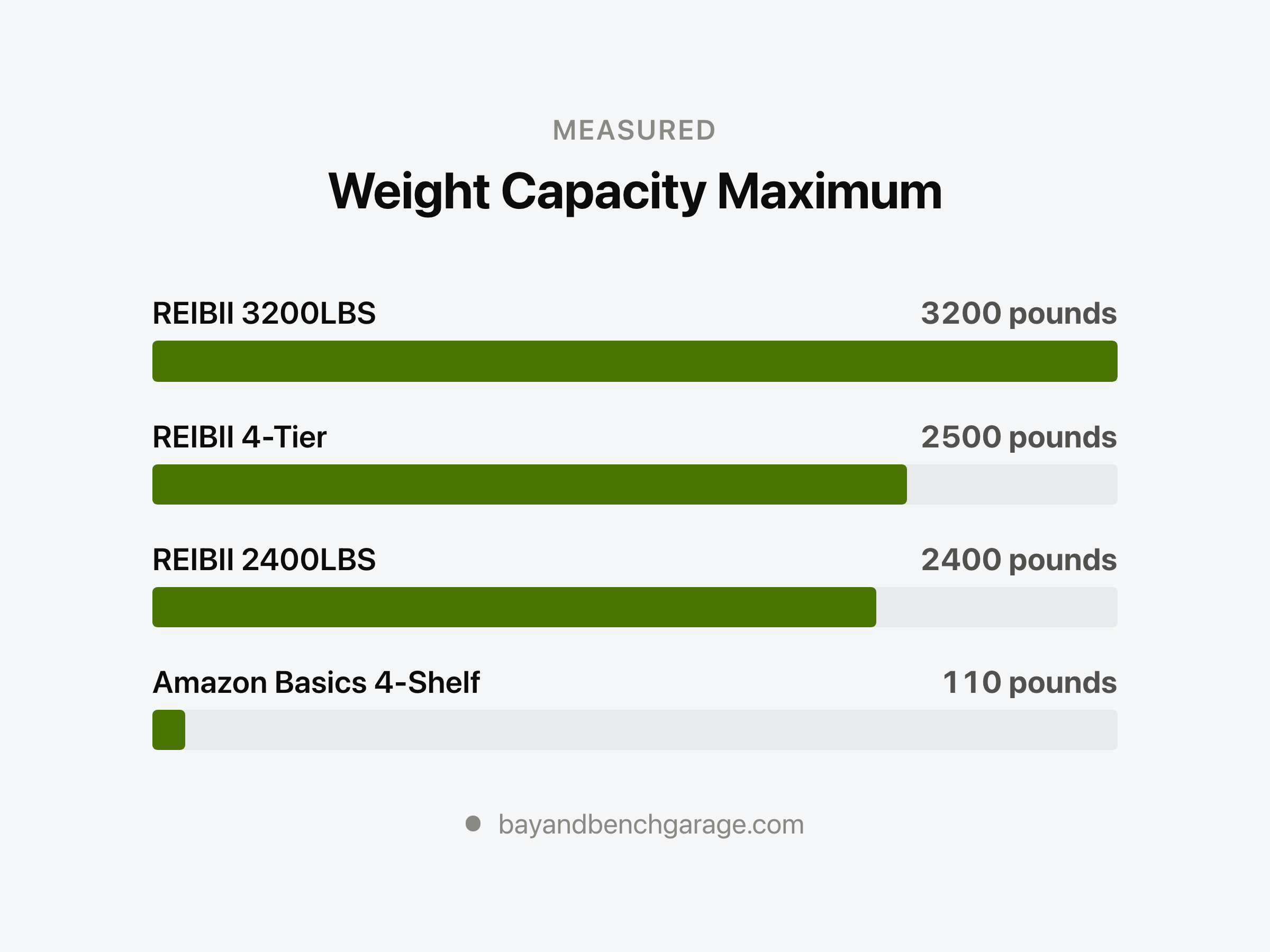
| Amazon Basics 4-Shelf | 14"D x 57.7"W x 57.7"H | Metal | 24.7 pounds | 4 | Best rolling demonstration |
| Metro Professional's Choice Commercial-Grade | 18"D x 24"W x 33"H | Metal | 11.93 kg | 3 | Best certified rating |
| REIBII 4-Tier | 24.02"D x 55.52"W x 75.62"H | Alloy Steel | — | 4 | Best maximum capacity |
| REIBII 3200LBS | 18"D x 55.5"W x 71"H | Alloy Steel | — | 5 | Best shallow footprint |
| Amazon Basics 3-Shelf | 13.39"D x 23.19"W x 30"H | Alloy Steel | 8.4 pounds | 3 | Best compact unit |
| REIBII 2400LBS | 16 x 35.55 x 72 inches | Carbon Steel, High Quality MDF Boards, Reinforcing ribs | 44 pounds | 5 | Best solid shelves |
Specifications as the listings give them. “Best for” is our assessment, not a manufacturer claim.
The answer, first
- The pick: REIBII 4-Tier, for it is the right answer for someone loading engine parts, bulk stock or full tool cases who needs both a very high per-shelf figure and deep shelves.
- Also worth it: Amazon Basics 4-Shelf, for it is the right answer for someone who needs to roll a loaded unit out of the way and wants to see, in one product, how much capacity casters cost them.
- How this was decided: published specifications and buyer reports across 6 products, compared below.
What each headline figure actually depends on
Every headline number in this group rests on a qualifier, and the qualifier is the spec. Car and Driver gives the Amazon Basics 4-Shelf unit as 1,400 lb total and 350 lb per shelf, and both figures are stated on leveling feet, which Car and Driver notes implies the caster configuration is rated differently. Car and Driver also found the unit top-heavy on its small casters.
The pattern repeats across brands. Bob Vila's capacity for the Seville Classics WEB690 is qualified as applying on standard feet, and the drawback listed for that unit is that capacity drops tremendously in the other configuration. Car and Driver's figure for the Seville Classics 5-Tier with wheels — 1,500 lb total, 300 lb per shelf — carries the same leveling-feet condition. Note what that means for a like-for-like read: both totals are quoted for a fixed installation, whatever mounting the unit ships with.
So when you scan any listing, read the condition first and the number second.
REIBII's own buying guide puts typical market phrasing at roughly 600 lb per tier and 2,500 to 3,000 lb total.
Is the capacity per shelf or for the whole unit?
A REIBII 55.5-inch-wide metal unit is marketed on a 3,200 LBS capacity claim, but the evidence sources never state a per-shelf figure for it, and none of them define how per-shelf and total-unit numbers relate.
That is the gap nobody writes about. None of these sources say whether total capacity is a budget you can spend anywhere on the frame, or whether it is simply the sum of per-shelf limits under even distribution. Heavy things go low because lifting them is unpleasant. The top tier holds an empty cooler.
Check both numbers against your actual load pattern:
- Per shelf: the limit for the single heaviest tier you plan to fill
- Total: the limit for the frame, posts and feet combined
- Distribution: an assumption no listing here states either way
REIBII's own buying guide warns that many brands advertise the total-unit figure rather than the per-shelf number because the bigger one looks more impressive, and puts common market phrasing at roughly 600 lb per tier against 2,500 to 3,000 lb total. REIBII also names "how much weight can these shelves really hold without bending" as the most-asked question on Garage Journal and r/HomeImprovement. Bending is the tell, though nothing in these sources quantifies how visible deflection relates to the rated load. Car and Driver's reviewers make the related point that wire shelving is less rigid than other options and will not store thousands of pounds.
Run the per-shelf figure first. The total matters second.
Do wheels weaken shelving over time?
A poster on the Fine Homebuilding forum asked exactly whether wheels make a unit weaker over time, and the thread never answered. Nothing in these sources answers it either, or explains why casters cut a published rating so severely.
What is documented is the size of the drop, not its cause: Reibii's own guidance puts the cost at 3,200 lbs without wheels against 661 lbs with them on its 60-inch-wide unit.
Car and Driver found the Amazon Basics wire unit top-heavy on its small casters, with some flex, though not flimsy overall.
With no mechanism documented anywhere, the conservative reading is simply to buy for whichever figure matches the configuration you will actually use.
Find your case
- Least number of shelves: Metro Professional's Choice Commercial-Grade at 3.
- The middle of the range: REIBII 4-Tier at 4.
- Most number of shelves: REIBII 2400LBS at 5, worth it for it is the right answer for storing loose hardware, paint cans and small tools.
Five questions to settle before you choose wheels
Fine Homebuilding's forum users treat mobility as the first purchasing decision, ahead of capacity and size. Work through these five in order before you add casters to anything.
- Does the listing publish a caster-specific rating at all? Car and Driver quotes the Amazon Basics 4-Shelf unit at 350 lb per shelf and 1,400 lb total specifically on leveling feet, with no caster figure given.
- If no caster rating exists, what do you assume? Nothing in these sources lets you predict the derate for a unit that doesn't publish both numbers. The one documented pair — Reibii's 60-inch wire unit dropping from 3,200 lb to 661 lb once wheels go on — is a single data point, not a rule.
- What does the load actually weigh? Gladiator's buying guide tells you to inventory sizes, shapes and weights first, and it is the step that determines which rating you actually need.
- How often will you move it? The less often a unit has to move, the less the wheeled figure has to govern your choice.
- Which units publish both figures? None of the units in these sources publish a footed and a wheeled rating side by side; only Reibii's guide gives both for a single unit.
How the six units compare once the qualifier is applied
Car and Driver gives the Amazon Basics 4-Shelf unit's leveling-feet figures as 1,400 lb total and 350 lb per shelf, and notes that the caster configuration is therefore rated differently. The qualifier is the specification.
Apply that lens and the units separate not by headline number but by what the headline number assumes. A REIBII 55.5-inch-wide metal unit is marketed on a 3,200 LBS capacity claim, though these sources do not give its depth, tier count, per-shelf figure or bracing.
Where deck type changes the answer
Open wire decking matters less for capacity than for what stays on the shelf: small items fall through, and Car and Driver notes wire shelves are more prone to rusting over time while wood shelves can rot and wear down, especially if they get wet. Reibii's own position is that steel is the only serious heavy-duty material, wood warping in humidity and plastic being weak — a position that sits awkwardly against Reibii's own MDF-decked corner shelf rated at 2,250 lbs, a tension none of these sources reconcile.
NSF certification comes up in these sources — Gladiator's Heavy Duty and EZ Connect Storage Racks carry it, as does a Trinity 5-Tier wire rack sold at Costco — but it is cited for food storage only, and no page says whether it implies anything about structural capacity.
Auditing shelving you already own: three measurements
Shelving already loaded in your garage can be inspected with a 4-foot straightedge, a ruler and a torpedo level, with the load in place. I have run none of these checks on the units above, and none of these sources set thresholds for what a measurement means, so treat the following as observation rather than a pass/fail test.
- Mid-span deflection. Lay the straightedge across the front edge of the loaded shelf, resting on the two posts, and measure the gap at the centre of the span. No source in this set relates a measured deflection to the rated load, or names a deflection limit for shelving.
- Recovery after unloading. Pull the load and measure again. Bob Vila lists bowing under heavy weight as the chief drawback of the HDX unit it tested, whose five shelves are each rated to hold 150 pounds and which bowed a little under drill presses and other heavy tools. What persistent bowing implies for the rating is not addressed anywhere in these sources.
- Post plumb and frame twist. Hold the level against each post front-to-back and side-to-side. Car and Driver found the CX plastic unit twists vertically when flexed, though testers judged its overall capacity and stability sound.
None of these sources say whether a rating assumes evenly spread weight or covers a concentrated point load such as a compressor foot or a single toolbox. A 25-year contractor cut and laid 1/4-inch plywood over the wire shelves of a 90" x 90" x 24" Husky unit so items would not fall through. No page states whether laying plywood over a wire deck changes its capacity, up or down.
Which unit suits which garage
For a shallow wall beside a parked car with nothing that needs to move, the REIBII 55.5-inch-wide unit is marketed on a 3,200 LBS claim; these sources give no depth, tier count or per-shelf figure for it, and no caster rating.
Loose hardware, paint cans and sockets belong on a closed deck. Reibii's 16-inch-wide 6-tier corner shelf is rated 2,250 lbs on a metal plus 5mm thickened MDF board build, though Car and Driver notes wood shelves can rot and wear down, especially if they get wet, so keep any wood deck off a slab that floods.
Where mobility matters, the Amazon Basics 4-Shelf unit is the documented case: 1,400 lb total and 350 lbs per shelf on leveling feet, with Car and Driver noting the caster configuration is rated differently and that the unit felt top-heavy on its small casters.
For a deep, high-capacity frame, Reibii lists a 55" W x 26" D x 84" H 6-tier unit rated 3,600 lbs per unit with five reinforcing ribs under each shelf.
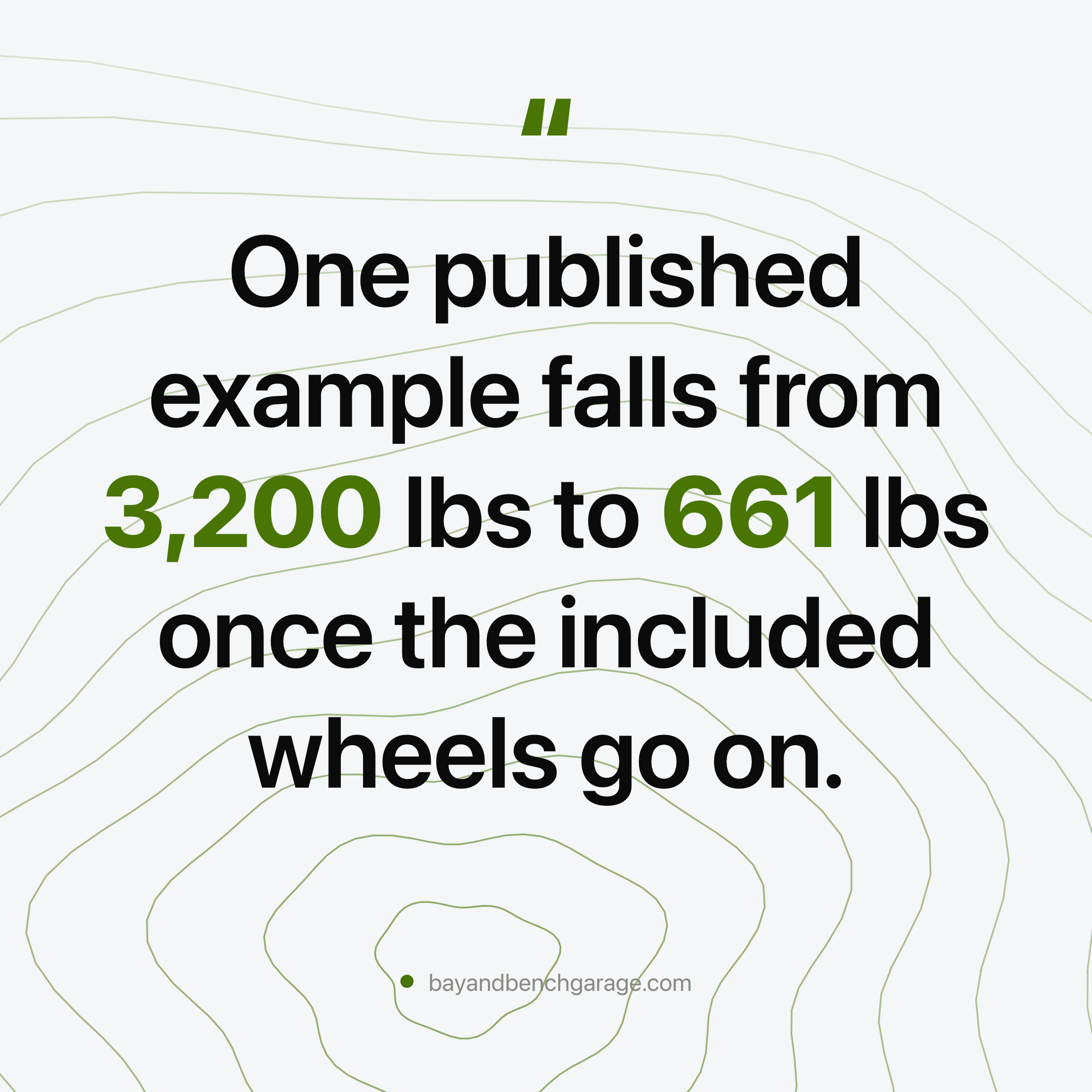
That 79.3% drop from 3,200 to 661 lbs is what Reibii's own guide reports for one unit with and without wheels. No source explains why the penalty is that large, or how to predict it for a unit that publishes only one number — which is the strongest argument for reading the qualifier before the figure.
The verdict
REIBII 4-Tier, best for it is the right answer for someone loading engine parts, bulk stock or full tool cases who needs both a very high per-shelf figure and deep shelves.
Not the right answer for everyone:
- For it is the right answer for someone who needs to roll a loaded unit out of the way and wants to see, in one product, how much capacity casters cost them: Amazon Basics 4-Shelf.
- For it is the right answer for a reader who wants a certified commercial rating rather than a marketing number, on a short unit that fits under a bench or window: Metro Professional's Choice Commercial-Grade.
- For it is the right answer for a shallow wall in a narrow garage where the reader still wants five tiers and a high total rating: REIBII 3200LBS.
Before you order the REIBII 4-Tier: wheels cut total capacity from 2,480 lb to 780 lb, so heavy loads mean swapping to feet
Questions
Do wheels reduce a shelving unit's weight capacity?
Yes, and sometimes drastically. Reibii's own buying guide rates a 60-inch wire unit at 3,200 lbs without wheels and 661 lbs with them — a 79.3% reduction on a unit that ships with casters. No published source explains the mechanism or lets you predict the derate for units quoting only one figure.
Is the weight capacity per shelf or for the whole unit?
Listings publish both, and brands often lead with the larger total. Reibii's guide puts typical market phrasing at roughly 600 lbs per tier against 2,500 to 3,000 lbs total. Plan against the per-shelf number for your heaviest tier first; the total governs the frame, posts and feet together.
Why does the same shelf have two different weight ratings?
Because the rating describes a configuration, not the frame. Car and Driver quotes the Amazon Basics 4-Shelf unit at 1,400 lbs total and 350 lbs per shelf specifically on leveling feet, noting the caster configuration is rated differently. Read the qualifier — feet, casters, distribution — before the number.
Sources
- The Best Heavy Duty Wire Shelving Unit for Garage Storage - Fine Homebuilding accessed 2026-08-03
- Expert Reviews accessed 2026-08-03
- Shelving Buying Guide | Gladiator accessed 2026-08-03
- Shelving Buying Guide | Gladiator accessed 2026-08-03
- The Best Garage Shelving for Sturdy Storage, Expert-Tested accessed 2026-08-03
- Beginner’s Guide: How to Choose Industrial Heavy-Duty Garage Shelving – Reibii accessed 2026-08-03