Garage Floor Coating: Which Type Suits Your Slab?
· 13 min read
As an Amazon Associate we earn from qualifying purchases. We compare manufacturer specs against what buyers report from their own garages. Links here may earn us a commission; no manufacturer has ever seen a draft.
Start With the Slab, Not the Chemistry
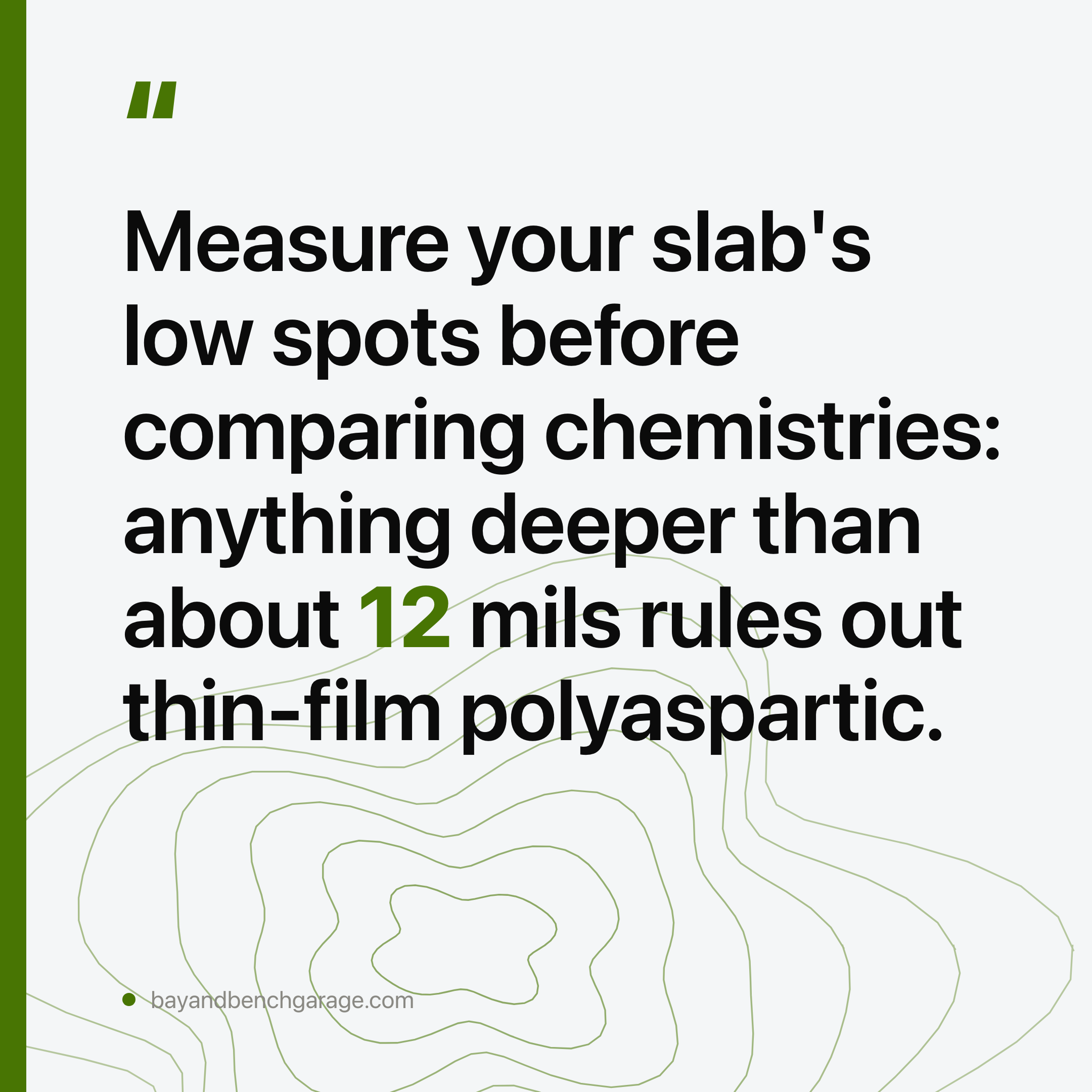
Measure your slab's low spots before you read a single chemistry comparison. If any of them are deeper than about 12 mils — roughly the thickness of three sheets of paper — polyaspartic is already out, and the garage floor coating you need is an epoxy built up thick. Duraamen puts the numbers plainly: epoxy mixed with self-levelling additives goes on up to 1/8 inch, while polyurea and polyaspartic are held to 10 to 12 mils per pass. A pitted, spalled or uneven floor is a filling job. Thin-film chemistries do not fill.
That single rule eliminates one option before taste, colour or cure time enters the decision, and it is the part the ranking pages skip. They rank chemistries. Slabs do not care about rankings.
What this piece decides is narrower and more useful: which of five DIY kits suits which slab, which climate, and which person holding the roller. It rests on published manufacturer specifications for those kits, not on any floor I have coated. Where a figure comes from a coating company's own technical team — ArmorGarage's 2026 guide, for instance, updated January 2026 — I say so, because a manufacturer describing its own chemistry is a source with an interest.
The uncomfortable finding is Garage Living's, and it runs through everything below: a poorly applied polyaspartic system will not outperform a well-applied epoxy. Application quality outweighs chemistry. Since ArmorGarage notes that cured epoxy penetrates the pores opened during prep and becomes part of the slab, getting it wrong means grinding concrete away, not repainting.
| Product | Product Dimensions | Color | Specific Uses For Product | Finish Type | Best for |
|---|---|---|---|---|---|
| ArmorPoxy Polyaspartic | 13 x 13 x 26 inches | — | — | — | Best for fast turnaround |
| Gorilla | — | Black | Basement, Garage, Retail Store, Warehouse | — | Best heavy-duty build |
| Rust-Oleum EpoxyShield | 1 Count (Pack of 1) | Tan | Interior | Gloss | Best known brand |
| DWIL Water-Based | 1 Fl Oz (Pack of 1) | Light Grey | Interior | High-Gloss | Best low-odour option |
| COLOR CARE | 120 Fl Oz (Pack of 1) | Gray | Interior | High-Gloss | Best simple 1-car kit |
Specifications as the listings give them. “Best for” is our assessment, not a manufacturer claim.
The answer, first
- The pick: COLOR CARE, for it is the right answer for a straightforward one-car concrete bay where you want a roller-and-go 2-part epoxy and nothing more complicated than that.
- Also worth it: ArmorPoxy Polyaspartic, for it is the right answer when the garage has to be back in service by tomorrow, or the slab runs outdoors onto a driveway or patio where sunlight would yellow an epoxy.
- How this was decided: published specifications and buyer reports across 5 products, compared below.
The Five Kits, Cheapest First
Five kits, ordered cheapest first.
The table below carries the specifications. What it cannot show is what each step in price actually buys, so read the prose alongside it.
At the bottom of the range you are buying chemistry and nothing else. The COLOR CARE Garage Floor Kit is a 2-part epoxy in a single gallon, gray, high-gloss, indoor only, with no applicators in the box and no primer step. Walk-on at 24 hours, car back at 72.
The DWIL kit spends its money differently. It is water-based rather than solvent-based, and the primer is included instead of sold separately — which matters on bare concrete, where adhesion is the whole game. The trade is film thickness. A water-based epoxy lays down less solid material than a 100% solids product. The listing gives 2.5 litres and no square-foot coverage at all.
Rust-Oleum rates it five times stronger than a standard one-part epoxy, and it is worth reading that claim precisely: the comparison is against a one-part product, not against other two-part epoxies. Applicators are in the kit.
Gorilla buys film. 100% solids means nothing evaporates out of the coating, so one coat leaves a genuinely thick build, and the manufacturer puts coverage at up to 275 sq ft with drive-on at 24 hours.
ArmorPoxy buys area and sunlight tolerance. Garage Living describes polyaspartic as a polyurea with added UV stability, which is why this is the only kit here rated for a driveway. It covers 500 sq ft — roughly double the one-car kits.
How long before I can park on it?
Four published figures disagree, and it is not clear they are answering the same question. Epoxy AZ gives epoxy a cure time of 24 to 72 hours. Rust-Oleum says three days before you drive on its epoxy. Garage Living, in a post by Drew Kerr dated 8 August 2019, says vehicle traffic is often unsafe for five to seven days. These figures are contested and none of the sources defines whether it means dry-to-walk, dry-to-drive, or full chemical cure, so they may not be measuring the same thing.
One possible explanation is that the figures describe different stages, none of them labelled clearly.
Foot traffic. Tack-free and walkable. On the Gorilla and COLOR CARE kits this is stated at 24 hours.
Tyre traffic. The film is hard enough to resist a hot tyre lifting it. COLOR CARE puts this at 72 hours; Rust-Oleum at three days for its epoxy.
Full chemical cure. Garage Living's five to seven days may sit here, though its post does not say so.
Now the part that looks backwards. Rust-Oleum's Concrete and Garage Floor Paint + Primer asks for five days before you drive on it — two days longer than the same brand's epoxy. ArmorGarage says paint air-dries and loses up to 50% of its mass to evaporation, leaving a thin film with a weak chemical structure sitting on the surface, while epoxy cures by chemical reaction between two mixed parts, ending in a hard monolithic surface.
Rust-Oleum labels the paint a "one-part garage floor coating". That phrasing does not tell you the product is paint, typically acrylic.
Working Time: Why 'DIY-Friendly Polyaspartic' Is Backwards
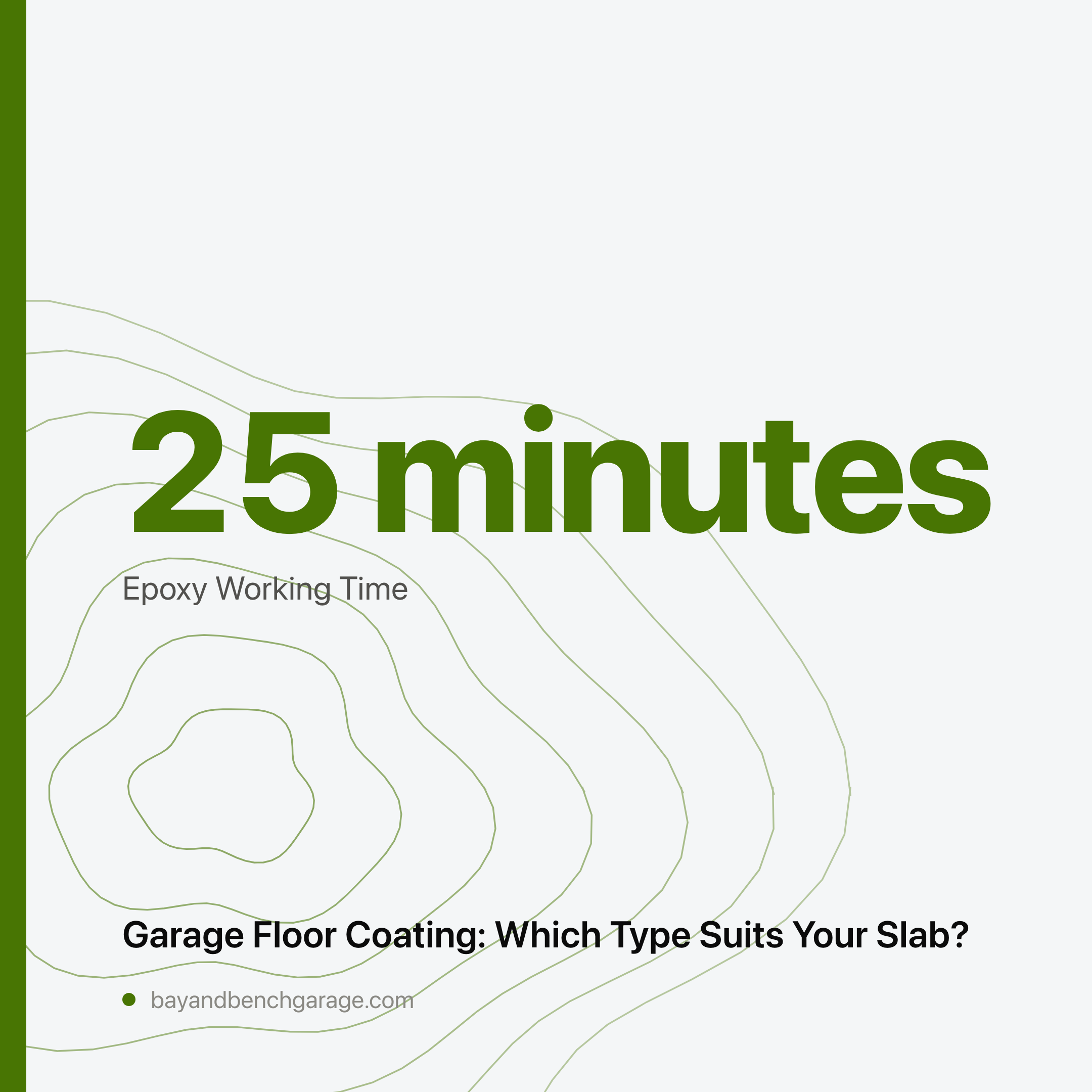
Epoxy resin gives you about 25 minutes of working time. Polyurea and polyaspartic give you 10 to 12. Duraamen puts those numbers side by side, and they invert the "most DIY-friendly" claim that sits at the top of most polyaspartic pages. Fast cure is a homeowner benefit. It is an installer penalty.
Garage Living makes the same point from the installer's side: the quick cure that gets a car back on the slab sooner leaves less working time and demands more skill and experience.
The trade is cure time bought back with working time.
Where the cold flips it
Cold weather reverses the argument, and it reverses it hard. In cold conditions epoxy takes 24 to 36 hours to cure, per Duraamen,. Polyurea and polyaspartic cure in 2 to 4 hours at 40°F or below.
The obvious fix for slow cold epoxy is a cold-cure hardener. Read what it costs you: Duraamen notes those hardeners leave the finished coating less UV stable — the exact weakness epoxy is already criticised for. So a cold-weather epoxy job with a cold-cure hardener trades away UV stability, which was a reason to consider polyaspartic in the first place.
If your slab is unheated and you are coating in November, the chemistry decision is largely made for you. The ArmorPoxy polyaspartic kit is the one rated to cure in that window without a hardener compromising its UV rating.
Kit by Kit: What Each One Is Actually For
Five kits, five different problems.
The DWIL water-based epoxy kit answers one question: ventilation. Low odour, low VOC, primer included rather than sold separately, topcoat 2-3 hours after the primer thinned 10% with water. Garage Living warns that the epoxy kits sold at home improvement stores are thinner and less durable than professional-grade systems. The listing gives 2.5 litres and no square-foot coverage, which makes planning a one-car bay guesswork. Interior only. If fumes are the deciding constraint, DWIL's kit is the one that resolves it.
Film build
Gorilla's kit is the thickest single coat here. Two-part 100% solids means nothing evaporates out, so what you roll on is what stays. Rust-Oleum EpoxyShield takes a different route: Rust-Oleum's own rating of five times stronger than a standard one-part epoxy. The evidence file records that epoxy can yellow under UV exposure, so both are better suited to a floor under a roof.
Cure window and bay size
COLOR CARE's 2-part kit is the simplest sequence: one gallon, no primer, roll and go. It asks 72 hours before a car returns, and covers one bay only. A double garage needs two kits, and the listing includes paint alone, so buy applicators.
ArmorPoxy is the only kit here that answers UV and area together. 500 sq ft, roughly double the one-car kits, and a clear gloss rated not to yellow outdoors — Garage Living notes epoxy can yellow under UV exposure, and describes polyaspartic as a polyurea with added UV stability. Twenty-five pieces, two layers, tack-free in 2-4 hours.
One thing no kit on this list claims: slip resistance. ArmorGarage is blunt that a coating is slip-resistant only when a nonslip additive is used.
Four Questions That Disqualify a Contractor
Ask a contractor about chemistry and you learn what they sell. Ask about prep and you learn how the floor was set up to last. Garage Living puts it plainly: a poorly applied polyaspartic system will not outperform a well-applied epoxy. So vet the installer, not the label. Four questions do most of the disqualifying:
- "How will you profile the slab?" Garage Living says the concrete must be profiled, usually by grinding or acid etching, then thoroughly cleaned, or even the best epoxy fails. Garage Living names grinding or acid etching as the usual methods.
- "What moisture test do you run, and what reading rejects the job?" Garage Living traces many DIY epoxy failures back to inadequate moisture testing or poor application conditions,.
- "What are you filling the cracks with, and when?" Rust-Oleum lists crack filling alongside cleaning, etching and priming as part of prep, and notes the full job from prep to coating can run several days.
- "Which coats go down on which day?" You want a sequence, not a duration.
Now the same-day question. Duraamen says an experienced contractor can install a two- or three-car floor in a single day with polyurea or polyaspartic, and Epoxy AZ says most polyaspartic systems install and fully cure within one day.
When Interlocking Tiles Beat Any Liquid Coating
Interlocking tiles are the correct answer in four situations, and none of them are about durability. Garage Living blames many DIY epoxy failures on inadequate moisture testing, and tiles sit on top of the slab rather than bonding to it. A rental garage is the second case, because ArmorGarage points out that cured epoxy becomes part of the concrete, and removing it means grinding away the epoxy along with part of the slab. Third: a slab you cannot profile, whether because you have no grinder access or because the surface cannot be profiled evenly. Fourth, a floor you want to take with you when you move. Tiles unclip.
What they give up is honest and significant. Garage Living's ranking notes that tiles and mats cover the concrete rather than protect it, and can trap moisture underneath — which means the same water problem that made them the right call can quietly get worse where you cannot see it. They are not coatings. Nothing bonds to your concrete.
Set that against what a crew can now do in a day. Duraamen states that with polyurea or polyaspartic, an experienced contractor installs a two- or three-car garage floor in a single day. If your slab is sound and dry, and you are hiring rather than rolling, that one-day install narrows the schedule advantage tiles offer. The tile case rests on the slab's condition, not on the calendar.
ArmorPoxy Polyaspartic — Best for fast turnaround
- Polyaspartic chemistry goes tack-free in 2-4 hours and fully cures in 24-48 hours, so the two layers can be laid in a single day
- UV-resistant clear gloss is rated not to yellow outdoors, unlike standard epoxy, so it suits driveways, patios, decks and balconies
- But: Fast cure means a short working window, which is unforgiving for a first-time applicator across a 500 sq ft floor
- But: Listing gives little detail beyond the box dimensions - no colour chip or coverage-per-coat breakdown to plan from
Gorilla — Best heavy-duty build
- 2-part 100% solids epoxy, so nothing evaporates out of the film and one coat leaves a genuinely thick build
- Stated coverage up to 275 sq ft from one gallon, sized to a standard 1-car bay
Rust-Oleum EpoxyShield — Best known brand
- Rust-Oleum EpoxyShield is the established name in the category and is backed by a stated no-peel promise
- Rated 5x stronger than 1-part epoxy, with hot tire pickup and chemical resistance
DWIL Water-Based — Best low-odour option
- Water-based epoxy with low odour and low VOC, aimed at poorly ventilated interior spaces
- Separate primer is included rather than sold on, which improves adhesion on bare concrete
- But: Water-based epoxy lays down a thinner, less solid film than the 100% solids kits, so wear resistance is lower
- But: Interior use only - not an option for a driveway or exposed slab
COLOR CARE — Best simple 1-car kit
- 2-part epoxy, stated to be more resilient than 1-part epoxy paints, at a single-gallon 1-car scale
- Rolls on with no primer step or multi-layer sequence to manage
- But: Indoor use only, with no UV claim, so it is not for driveways or sun-exposed slabs
- But: 72 hours before a car returns - three times the wait of the polyaspartic kit
Where to Stop Spending
For most one-car bays, a 100% solids 2-part epoxy is a defensible stopping point. Garage Living advises looking for epoxy systems with at least 3 to 4 mils of dry film thickness. Gorilla's kit is that stopping point: one coat, 275 sq ft, drive-on at 24 hours. Spend above it only for a reason you can name. A 500 sq ft slab that runs out to a driveway is such a reason, and the ArmorPoxy polyaspartic kit is the only option here rated not to yellow in sun. A basement bay with no ventilation is another, which is what DWIL's water-based kit is for, at the cost of a thinner film. Rust-Oleum EpoxyShield is a water-based epoxy that can be embellished with the colour chips supplied in the kit; COLOR CARE buys simplicity and asks 72 hours before the car returns. Duraamen's own recommendation for inexperienced applicators is an epoxy basecoat under a polyaspartic topcoat, neither chemistry alone.
Garage Living puts basic floor paint under $30 a gallon and says it chips and peels within months in a working garage; Epoxy AZ says a cheap coating may need replacing in a few years while a premium system can last a decade or more with minimal maintenance. I have not applied any of these five. This comparison reads manufacturer specifications against each other and flags where a listing leaves a gap. Measure your low spots. Then buy for the deepest one, not the glossiest photo.
The verdict
COLOR CARE, best for it is the right answer for a straightforward one-car concrete bay where you want a roller-and-go 2-part epoxy and nothing more complicated than that.
Not the right answer for everyone:
- For it is the right answer when the garage has to be back in service by tomorrow, or the slab runs outdoors onto a driveway or patio where sunlight would yellow an epoxy: ArmorPoxy Polyaspartic.
- For it is the right answer for a working garage or workshop where the floor takes solvents, dropped tools and hot tyres, and you want the thickest film from one coat: Gorilla.
- For it is the right answer if you would rather buy the system with the longest track record and a warranty behind it than gamble on an unfamiliar label: Rust-Oleum EpoxyShield.
Before you order the COLOR CARE: indoor use only, with no UV claim, so it is not for driveways or sun-exposed slabs
Questions
What is the best coating to put on a garage floor?
It depends on the slab, not the chemistry ranking. If low spots exceed roughly 12 mils, you need an epoxy built up thick, since polyaspartic is limited to 10-12 mils per pass. For most sound one-car bays, a 100% solids two-part epoxy is a defensible stopping point.
What is the downside of an epoxy garage floor?
Epoxy can yellow under UV exposure, so it suits floors under a roof rather than driveways. It cures slowly in cold weather — 24 to 36 hours — and cold-cure hardeners reduce UV stability further. Because cured epoxy bonds into the slab's pores, removing it means grinding concrete away.
How long before I can park a car on a new garage floor coating?
Published figures range from 24 hours to seven days and rarely define which stage they mean. Walk-on is often 24 hours; tyre traffic typically 72 hours or three days; some installers say full cure takes five to seven days. Follow your specific product's drive-on figure.
Can garage floor coating be applied in cold weather?
Polyurea and polyaspartic cure in 2 to 4 hours at 40°F or below, while epoxy needs 24 to 36 hours in cold conditions. Cold-cure epoxy hardeners speed that up but leave the coating less UV stable, trading away the very advantage polyaspartic offers.
When are interlocking garage tiles a better choice than epoxy?
Tiles win when the slab has a moisture problem, when you rent the garage, when the surface cannot be profiled evenly, or when you want to take the floor with you. They sit on top rather than bonding, but they cover concrete instead of protecting it and can trap moisture underneath.
Sources
- Choosing the Best Garage Floor Coating: Epoxy vs Polyaspartic accessed 2026-08-03
- Ranking the Best (and Worst) Garage Floor Coating Options accessed 2026-08-03
- How to Choose the Best Garage Floor Coating accessed 2026-08-03
- The Complete Garage Floor Coating Guide 2026 accessed 2026-08-03
- What Is the Best Coating for Garage Floors in 2026? accessed 2026-08-03
- The Complete Garage Floor Coating Guide 2026 accessed 2026-08-03