Garage Cabinet Depth: Measure the Car Door First
· 10 min read
As an Amazon Associate we earn from qualifying purchases. We compare manufacturer specs against what buyers report from their own garages. Links here may earn us a commission; no manufacturer has ever seen a draft.
The Number That Sets Your Depth Is Door Projection, Not 24 Inches
Measure the door, not the cabinet. Gladiator puts the industry standard for base garage cabinets at 24 inches deep, with wall-mounted units at about 12 inches, and VAULT publishes the same 24-inch figure for both base and tall cabinets. Neither names a standards body or document behind the figure, and other vendors disagree: Kinbox puts the useful range at 18 to 24 inches and The Garage Experience calls 16 to 18 inches most common. Neither number knows how wide your car door swings. The figure that actually sets garage cabinet depth is your open-door projection minus the gap you already have between the parked car and the wall.
That subtraction is the whole exercise. Armadillo Tough gives the method plainly: park where the car normally sits, measure from the wall to the car's side, then measure how far the doors swing before you pick a depth. No source consulted here publishes door-swing figures by vehicle class, so the measurement has to be taken in your own garage rather than read off a table. The rest of this article works from that measurement, plus your parking tolerance, toward the depth you can install at each position along the wall. Gladiator itself warns that published depths vary by product, so check the specific cabinet.
| Product | Product Dimensions | Material | Item Weight | Number Of Shelves | Best for |
|---|---|---|---|---|---|
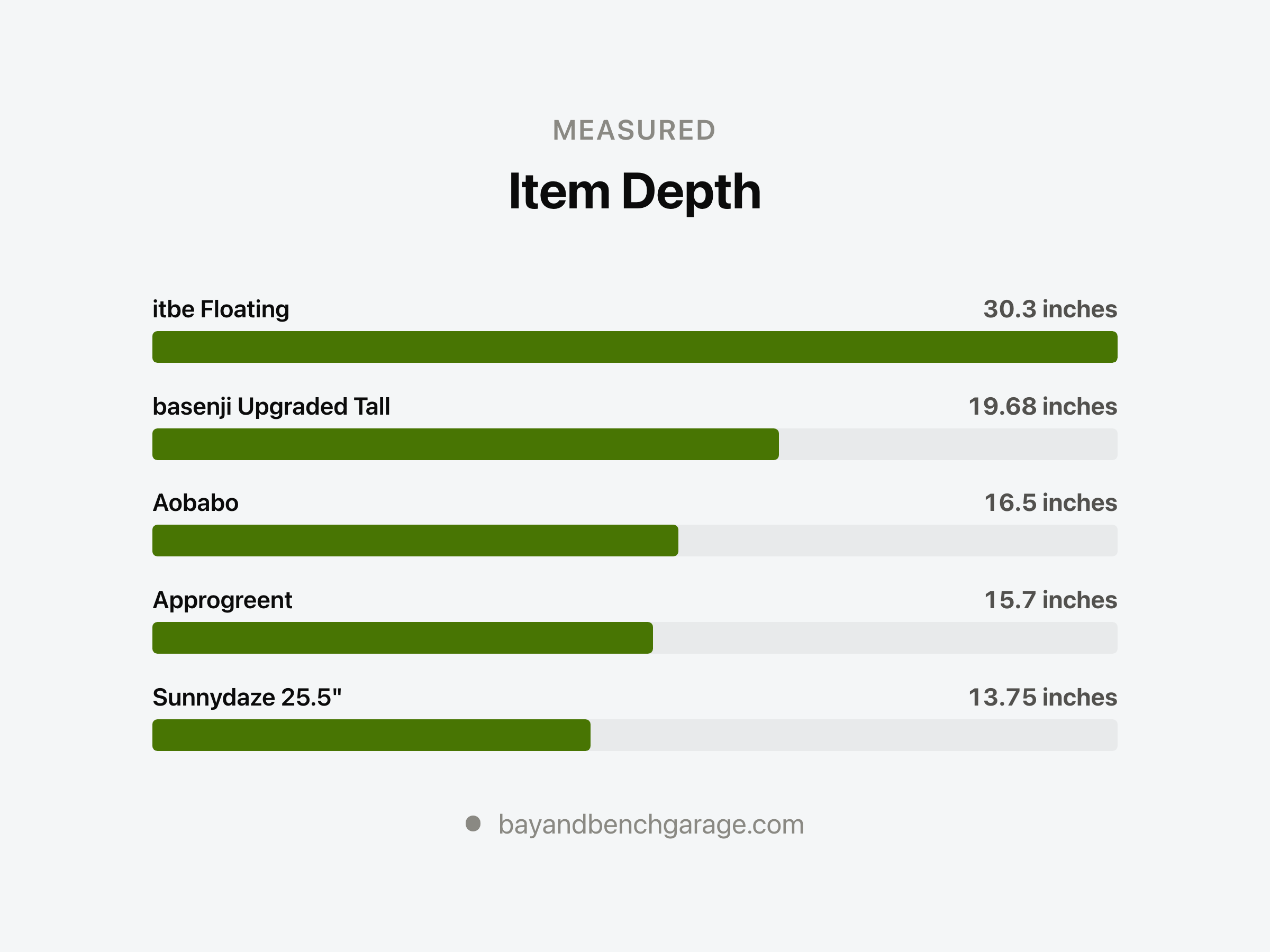
| itbe Floating | 12.5"D x 30.3"W x 30"H | Alloy Steel | 34 pounds | 1 | Best shallow clearance |
| Aobabo | 16"D x 32"W x 71"H | Metal | — | 5 | Best narrow full-height |
| Approgreent | 15.7"D x 31.5"W x 70.87"H | Alloy Steel | 87 pounds | 5 | Best fixed and secured |
| basenji Upgraded Tall | 19.68"D x 39.37"W x 70.87"H | Metal | — | 4 | Best deep and mobile |
| Sunnydaze 25.5" | 13.75"D x 23.25"W x 25.5"H | Powder-coated steel | 9.8 pounds | 1 | Best narrow footprint |
| pozdeg 47.25" White | 11.8"D x 23.6"W x 47.25"H | Steel | 37.5 pounds | 3 | Best half-height |
| 503 | — | Cold-rolled steel | — | — | Best deep capacity |
Specifications as the listings give them. “Best for” is our assessment, not a manufacturer claim.
The answer, first
- The pick: itbe Floating, for when the car door swings within inches of the wall and only a shallow, wall-hung cabinet will clear it.
- Also worth it: Aobabo, for when you want a full-height tool cabinet but the aisle beside the car is tight enough that every inch of depth counts.
- How this was decided: published specifications and buyer reports across 7 products, compared below.
Depth by Garage Width: Where the 24-Inch Run Stops Being Possible
Garage width constrains depth as much as any car door does. Kinbox says to keep at least 36 inches of clear space in front of cabinets so doors and drawers open, and Armadillo Tough independently lands on the same 36-inch walking path. Subtract both from the interior width and see what's left.
Narrow garages. The Garage Experience puts the rule of thumb for narrower garages at 12 to 16 inches of depth. No source consulted works the subtraction for a given interior width and vehicle, so the only reliable version of it is the one you do with a tape in your own bay.
One further caution: depth you can install is not necessarily depth you will use. Kinbox reserves 24-inch depth for big bins, bulky sports gear and yard tools. Kinbox notes that small items can get lost in deeper cabinets, and Armadillo Tough makes the same point. Smaller supplies do better in shallow cabinets where they can't disappear to the back.
Measure your interior width first.
Hidden Depth: What a Nominal 24-Inch Cabinet Actually Consumes
A nominal depth figure describes the exterior of the cabinet. VAULT notes that depth is measured front to back, and none of the sources consulted publish an interior usable depth for any cabinet. So a 12-inch cabinet does not store a 12-inch item, and no page quantifies the deduction for doors, hardware or face framing.
What is published is the clearance figure: both Kinbox and Armadillo Tough independently specify about 36 inches of clear space in front of garage cabinets so doors and drawers can open.
Cabinets Compared on Depth, Height and Footprint
Kinbox describes 12 inches as the tight-spot depth for spray cans and hand tools, 18 inches as the middle ground for power tools and medium bins. That maps onto this group almost exactly.
The roughly 12-inch class. Wall-hung units keep the floor clear: the Gladiator Full-Door Wall GearBox measures 12 by 28 by 28 inches and is rated 40 lb per shelf and 150 lb total, and Bob Vila measured the same box at 150 pounds across two adjustable steel shelves with no built-in lock. Craftsman's wall cabinet shares those 12 by 28 by 28 dimensions but is rated 100 lb per shelf and 200 lb total, and Car and Driver still found it rather small for large tools. The Vingli wall cabinet is 12 by 30 by 30, rated 55 lb per shelf and 165 lb total. The Manhattan Comfort Fortress floating cabinet is 12.5 inches deep (30 by 30.3 by 12.5) in 25-gauge stainless steel. Car and Driver notes that a wall cabinet's real limit usually comes from the mounting method rather than the cabinet, and Bob Vila found shallow wall-mounted cabinets limited in capacity next to floor units and not ideal for bulky power tools.
The roughly 18-inch class. Bob Vila's Seville Classics UltraHD rolling cabinet is 18 inches deep (72 by 36 by 18), with three adjustable shelves plus a fixed base shelf, each rated 150 pounds. The Rubbermaid freestanding double-door cabinet is also 72 by 36 by 18, weighs 68 pounds, and holds up to 680 pounds across four shelves; Bob Vila lists a Husky freestanding cabinet at 18.3 inches deep. Car and Driver's stated downside of floor cabinets is footprint, and it notes rolling cabinets also eat floor space and aren't as sturdy or sure-footed.
Find your case
- Least number of shelves: itbe Floating at 1.
- The middle of the range: basenji Upgraded Tall at 4.
- Most number of shelves: Approgreent at 5, worth it for when the cabinet has to stay put.
When the 18-Inch Rule Near Parked Cars Fails
The 18-inch figure is a general recommendation, not a result derived from any particular car or bay. A long-doored two-door car and a sliding-door minivan make very different demands on the wall beside them, and none of the sources consulted publish swing figures for either, so the rule cannot be checked without measuring.
Armadillo Tough recommends about 18 inches of depth for cabinets near parked cars rather than the 24-inch base-cabinet standard, and warns that any chosen depth be checked against door swing and walkways. That second instruction is the one that matters. Kinbox puts the useful range at 18 to 24 inches; The Garage Experience gives 12 to 24 with 16 to 18 most common, and calls 18 the value depth. All three are describing an average bay, not yours.
No source consulted publishes swing figures by door type, so there is no table to consult here. Measure your own door with a tape before you buy depth: Armadillo Tough's instruction is to park where the car normally sits, measure from the wall to the car's side, and measure how far the doors swing.
Zone the Wall: Nose, Door, Rear
A parked car does not present a uniform obstacle along the wall. The nose is narrow, the door swings wide, and the tail sits clear again. Depth can follow that shape. Kinbox recommends mixing depths rather than picking one, and places shallow cabinets near entrances and car doors while deep cabinets go along long uninterrupted walls, away from utility panels and walkways.
Kinbox makes the same argument in principle, recommending 12-inch wall cabinets for small frequently used items above 24-inch floor cabinets for bulk, and placing shallow units near entrances and car doors while deep ones go along long uninterrupted walls. The zoning here is the same idea applied horizontally rather than vertically.
Front zone, ahead of the front wheels. Armadillo Tough says deeper cabinets belong in the main work zone, for power tools, larger bins and paint cans.
Door zone, the swing arc. Kinbox places shallow cabinets near car doors; a wall-hung unit such as the 12-inch Gladiator Full-Door Wall GearBox keeps the floor clear entirely.
Rear zone, behind the rear door. Mid-depth freestanding units such as the 18-inch Rubbermaid double-door cabinet fit here.
Mark the three zones on the floor with tape before you buy anything. Open the car door at each. The tape tells you which cabinet goes where, and it will not match the tidy single-depth run you had in mind.
If you want the shallow cabinet in the door zone off the floor entirely, a wall-mounted unit is the one built for it.
Why Uppers Are 12 Inches Deep — and It Isn't Your Head
Sources disagree about why upper garage cabinets are 12 inches deep. VAULT explains the 12-inch wall cabinet as head-clearance: shallow uppers stop you hitting your head. Armadillo Tough gives two reasons of its own, less overhead bulk and the fact that you can see what's inside. Kinbox is the one that says it plainly: wall cabinets run around 12 inches so they don't interfere with car doors or mirrors.
That distinction may change where you hang the cabinet, though none of the sources consulted give mounting heights, mirror heights, or a door-swing envelope, so the interaction between upper-cabinet height and depth cannot be quantified from them. Armadillo Tough's related advice is to measure floor-to-ceiling at the lowest point on each wall and note garage door tracks, opener arms, and low beams or soffits.
Right depth, wrong height, is still a dented door.
Failure Modes, and the Depth Each One Starts At
Too little clearance doesn't announce itself with a crash. It shows up as habits:
- Parking further out than you used to.
- Squeezing out of a part-opened door.
- Drifting toward the far wall and losing the walkway on the other side.
None of the sources consulted assign threshold gaps to these outcomes, so the numbers have to come from your own bay. What they do give is the clearance floor: Kinbox and Armadillo Tough both call for about 36 inches of clear space in front of cabinets, and Armadillo Tough warns that any chosen depth be checked against car door swing and walkways.
Which depth suits which bay
Match the bay to the depth. Beside a car door, the shallowest thing that works wins: a 12-inch wall unit such as the Gladiator Full-Door Wall GearBox (12 by 28 by 28, 40 lb per shelf and 150 lb total) keeps the floor clear, though Bob Vila found shallow wall cabinets limited in capacity and not ideal for bulky power tools. Want more capacity on the floor? The 18-inch Rubbermaid freestanding double-door cabinet holds up to 680 pounds across four shelves, and Armadillo's Garage Gear Locker is rated to 750 lbs with adjustable shelves and full-height interior space.
This comparison is built on published manufacturer specifications and the geometry of door swing, not on cabinets I installed and lived beside. Gladiator itself warns that depth varies between cabinets and that you should check the specific product's measurements. Do that. Then anchor whatever you buy to a stud, as both Gladiator and Kinbox insist, because a cabinet you brush past weekly is a cabinet that eventually leans.
The subtraction from the opening still holds: open-door projection against your existing wall-to-car gap. Do it at several points along the wall rather than one, and Kinbox's advice to mix depths, shallow near car doors and deep along uninterrupted walls, may serve you better than a single-depth run.
The verdict
itbe Floating, best for when the car door swings within inches of the wall and only a shallow, wall-hung cabinet will clear it.
Not the right answer for everyone:
- For when you want a full-height tool cabinet but the aisle beside the car is tight enough that every inch of depth counts: Aobabo.
- For when the cabinet has to stay put and stay locked in a narrow bay shared with kids' bikes and household overflow: Approgreent.
- For when the bay is wide enough to give up 20 in. of depth and you want the cabinet rolled out of the door's arc when it isn't in use: basenji Upgraded Tall.
Before you order the itbe Floating: shelf rated to only 44 lbs — not for heavy hand tools or paint by the case
Questions
How deep are standard garage cabinets?
Gladiator and VAULT both publish 24 inches for base and tall cabinets, with wall units around 12 inches. Neither cites a standards body. Other vendors disagree: Kinbox gives a useful range of 18 to 24 inches, and The Garage Experience calls 16 to 18 inches most common.
How much space do you need between garage cabinets and a car?
Kinbox and Armadillo Tough independently call for about 36 inches of clear space in front of garage cabinets so doors and drawers can open and you can still walk past. Beyond that floor, the deciding measurement is your own car door's swing, taken where the car normally parks.
Should garage base cabinets be 18 or 24 inches deep?
Armadillo Tough recommends about 18 inches near parked cars instead of the 24-inch base standard, reserving deeper boxes for the main work zone. Kinbox keeps 24 inches for big bins, bulky sports gear and yard tools, and warns small items get lost at that depth.
How far does a car door swing out when fully open?
None of the manufacturers or review sources consulted publish door-swing figures by vehicle class, so there is no table to look up. Armadillo Tough's method: park where the car normally sits, measure wall to car side, then measure how far the door swings before choosing depth.
Why are upper garage cabinets only 12 inches deep?
Sources give different reasons. VAULT frames 12-inch uppers as head clearance. Armadillo Tough cites less overhead bulk and better visibility of contents. Kinbox says plainly that wall cabinets run about 12 inches so they don't interfere with car doors or mirrors.
Sources
- Garage Cabinet Buying Guide | Gladiator accessed 2026-08-04
- SITE NAVIGATION accessed 2026-08-04
- What Is The Best Depth for Garage Cabinets? accessed 2026-08-04
- Properly Measure for Garage Cabinets accessed 2026-08-04
- How Deep Are Standard Garage Cabinets? - The Garage Experience accessed 2026-08-04
- Expert Reviews accessed 2026-08-04
- The Best Garage Cabinets of 2026 | Tested by Bob Vila accessed 2026-08-04
- Garage Cabinet Buying Guide | Gladiator accessed 2026-08-04
- Properly Measure for Garage Cabinets accessed 2026-08-04
- 5 Important Factors to Consider When Buying Garage Cabinets accessed 2026-08-04