Garage Bike Storage Fails on Geometry, Not Price
· 13 min read
As an Amazon Associate we earn from qualifying purchases. We compare manufacturer specs against what buyers report from their own garages. Links here may earn us a commission; no manufacturer has ever seen a draft.
Measure three clearances before you shop
Wall, ceiling or floor is decided by three tape-measure numbers, not by price: usable wall width per bike, the depth you must leave clear in front of the rack, and the hook-to-floor envelope. Take those three figures before you look at a single garage bike storage product. Geometry is what kills installs. A rack rated to 330 lb is useless if the last bike's handlebars hit a doorframe.
What is at stake is a set of holes in a stud you cannot un-drill. If you measure first, you will know before you buy whether your bay takes a single hook, a six-bike rail or a freestanding stand, and which of those is ruled out. Here are the three numbers.
- Wall width per bike. VelociRAX gives 28.25 inches of wall for two bikes on its Tilt & Pivot and 113 inches for eight: roughly 14 inches per bike at eight, against 14.1 inches per bike at two. Its support brackets set at 1-inch increments.
- Vertical rack spacing, single height. Madrax says vertical hooks mounted at one common height need at least 24 inches between them, or handlebars make them unusable.
- Vertical rack spacing, staggered. Staggering with 8–12 inches of vertical offset cuts that to 16 inches recommended, 14 inches absolute minimum, the same trick the six-hook rails ask you to apply yourself.
- Corner allowance. Madrax puts the centre of a vertical rack at least 15 inches from a perpendicular wall so standard bars clear.
- Swing and aisle depth. Madrax allots 72 inches of length for a standard bicycle and wants 60 inches of aisle beyond its tyre, 48 inches minimum. For a pivoting rack, that arc is the number: Cycling Weekly puts loaded Steadyrack rotation at close to 180 degrees, Cyclingnews at up to 160.
- Hook-to-floor envelope. Ground clearance of at least 8 inches, plus 72 inches of bike, plus the lift height to clear the hook depth. On those figures, a wall much under about 80 inches leaves no room for the lift.
| Product | Product Dimensions | Material | Item Weight | Color | Best for |
|---|---|---|---|---|---|
| monTEK Enhanced | 7.1"D x 78.5"W x 5.4"H | Alloy Steel, Plastic | 9.8 pounds | Black | Best for multiple bikes |
| TORACK | 6"D x 16"W x 3.5"H | Stainless Steel | 5 pounds | Black | Best modular wall rail |
| Dirza | 5.3"D x 10.1"W x 5.1"H | Iron, Rubber | 1.2 pounds | 1 pack | Best single-bike hook |
| PRO BIKE | 8.2"D x 8.7"W x 8.66"H | Alloy Steel | 1 g | Black | Best horizontal mount |
| Leonardo | 0.04"D x 11"W x 0.08"H | Alloy Steel | 16 ounces | 1 Bike Hook with Tray | Best tidy vertical hook |
| Bike Nook | 23.5"D x 22"W x 30"H | Alloy Steel | 2.2 pounds | Black | Best no-drill option |
| Simple Houseware 5-Bike | 14.5"D x 71.5"W x 14"H | Alloy Steel | 1252 g | Silver | Best walk-in parking |
| Feedback Sports Rakk | 17.75 x 17.25 x 21.75 inches | Steel | 2.7 kg | Black | Best frame protection |
| Mythinglogic 3-Bike | 20.9"D x 35"W x 33.1"H | Metal | 5 pounds | Black | Best family gear station |
| BIRDROCK | 21.5"D x 47.4"W x 40.9"H | Alloy Steel | 19.6 pounds | 4 Bike Rack - Black | Best outdoor freestanding |
Specifications as the listings give them. “Best for” is our assessment, not a manufacturer claim.
The answer, first
- The pick: Bike Nook, for you rent, or the garage walls are masonry you would rather not drill, and the bike still needs to stand upright.
- Also worth it: monTEK Enhanced, for you have a long stretch of empty garage wall and a household of bikes that all need to hang at once.
- How this was decided: published specifications and buyer reports across 10 products, compared below.
What this comparison is built on
I have not hung a bike on any of these ten racks. Every dimension, load rating and tyre limit here comes from the manufacturer's published listing, none of which I have independently verified, and I say so wherever a figure appears. What I have done is compare those published numbers against each other on the same four attributes, which is a different job from testing. Wirecutter's guide, updated April 4, 2026, puts about 30 hours into research and hands-on testing of the 10 most viable options, and checked its frame-damage advice with frame builder Lennard Zinn and Ric Hjertberg at Wheel Fanatyk. This is not that.
It is the check that comes first. Specifications tell you whether a rack can physically go where you need it before anyone's testing notes matter.
By the end you will have three measurements written down and a shortlist of two or three racks that fit them. CycleSafe notes that published parking dimensions are general guidance only, so check local codes if you are fixing anything permanent.
The ten racks on the same four attributes
Four attributes separate these ten racks: format, stated load rating, tyre or wheel limit, and footprint. Everything else is finish. Read the table for the ten-second answer, then use the prose below to work out what each step up buys.
The cheapest formats here are single-bike fixed hooks. Dirza's own listing rates its hook at 65 lb into one stud. Delta rates the Leonardo at 40 lb with a tyre limit under 2.5 inches, and PRO BIKE TOOL rates its horizontal cradle at 48.5 lb; none of these figures come from independent testing. One bike each, one hole pattern each.
Segmented and long-rail wall systems are the next step. TORACK's listing gives three 16-inch rails and six hooks with a 66.2 lb system rating and a 4.4-inch tyre limit. monTEK states that its single 78.5-inch rail carries six hangers, 55 lb per hook, 330 lb total, but caps rim width at 3.5 inches.
Where the per-bike arithmetic flips
VelociRAX prices its Tilt & Pivot wall rack from $170 for two bikes to $570 for eight: roughly $71 per bike at full capacity, against $85 per bike at two. StoreYourBoard lists its G-Sport Pro adjustable wall system at $349.99 with a 500 lb rating, and freestanding G-Bike racks at $299.99 for five bikes and $399.99 for eight. Single hooks undercut all of those at one or two bikes. On these prices the crossover appears to sit somewhere around four bikes, though no source establishes the figure: past that point, a hook per bike plus the wall length each hook wastes may cost more per bike than one segmented system, and StoreYourBoard's cheapest multi-bike wall rack, a Blackstone 2-bike at $34.99, rises only to $79.99 for eight.
Floor formats price differently again, because they buy no wall at all. Feedback Sports' listing rates the Rakk at 75 lb, the highest single-bike figure here, in a 17.75 x 17.25-inch footprint. Simple Houseware states that it parks five bikes across 71.5 inches of floor. BIRDROCK HOME gives 47.4 by 21.5 inches for four and rates its top shelf at only 19.6 pounds.
How much weight can a wall rack actually hold?
Published capacities disagree with each other.
The clearest case is the Steadyrack. Cyclingnews' spec box gives its maximum supported weight as 15.9 kg / 35 lb. The body text of that same review says the rack accommodates bikes as heavy as 35 kg / 77 lb. Both figures sit on one page. Cycling Weekly gives 35 kg / 77 lb, as does the body text of the Cyclingnews review, so that is the better-supported figure to plan against, though the rating remains contested. The 35 lb figure reads like a unit conversion collapsed halfway, but no source explains the discrepancy.
Now run a 25 kg e-bike against it. Under the 77 lb figure Cycling Weekly gives you have 10 kg of headroom. Under the spec-box 35 lb figure you are 9 kg over, and a reader who trusts the wrong number either buys nothing or buys something else entirely.
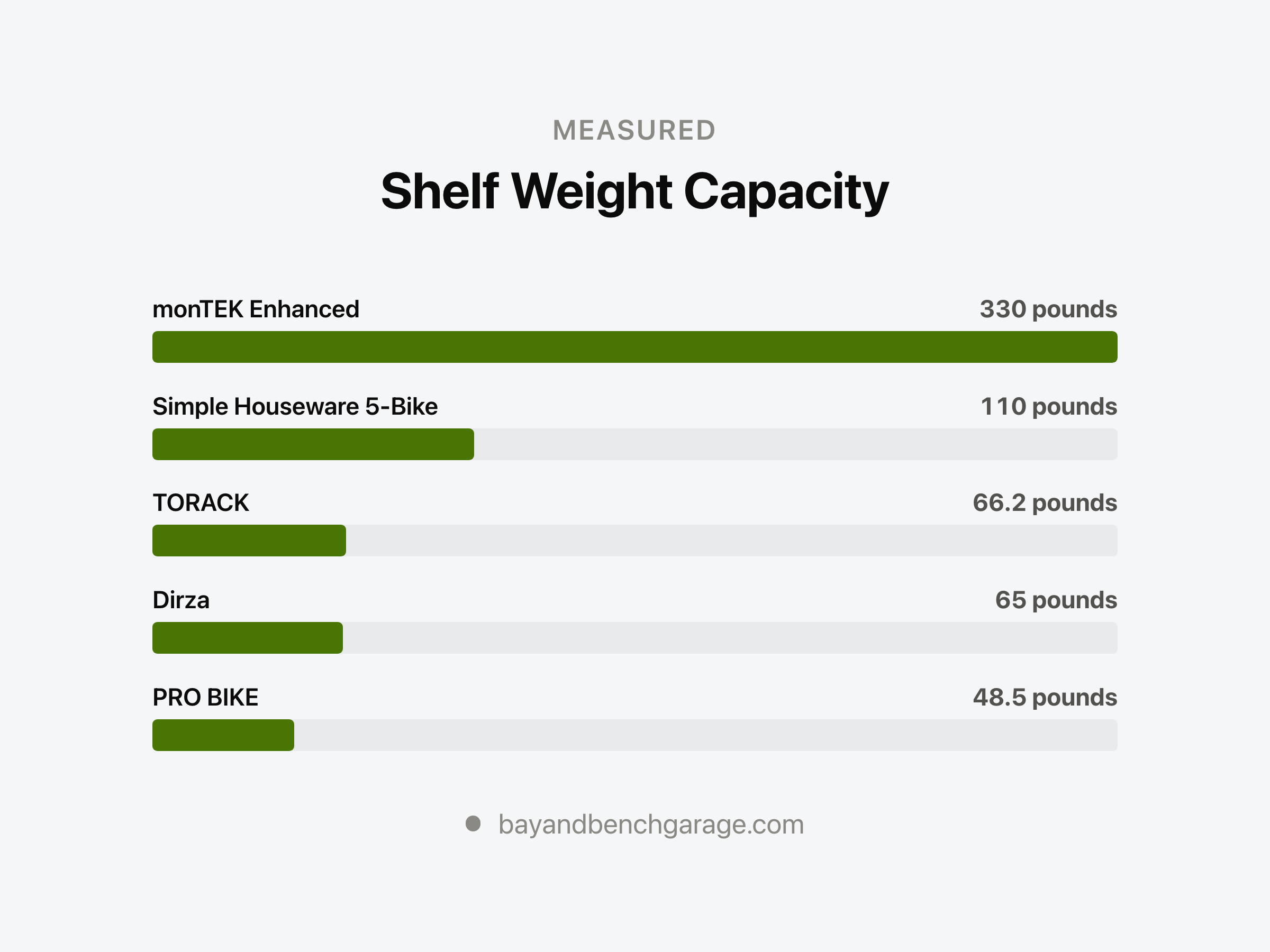
Against the ten racks here, 25 kg (55 lb) eliminates most of the wall options outright. Delta lists the Leonardo at 40 lb. PRO BIKE TOOL publishes 48.5 lb. TORACK gives 66.2 lb across the whole six-hook system, which is a system total, not a per-hook figure. Three e-bikes on it is not a plan. Dirza lists its single hook at 65 lb. On the manufacturers' own numbers, only monTEK's 55 lb per hook and 330 lb total clears a 25 kg bike on every hook, which points to monTEK's 78.5in six-hanger rail if the fleet is heavy, though no independent test of any of these ratings was available.
Park Tool publishes no number at all for its 451 hook, saying only that a correctly installed hook will support just about any bike. That is not a rating. Treat an absent figure as unknown, not generous.
Find your case
- Least number of shelves: Dirza at 1.
- The middle of the range: TORACK at 3.
- Most number of shelves: monTEK Enhanced at 6, worth it for you have a long stretch of empty garage wall and a household of bikes.
Tyre width is the hard ceiling, not capacity
Three inches is where the shopping stops. Above a rack's stated tyre limit, a stronger rack does not help you: the cradle geometry itself excludes the wheel, and load rating is irrelevant. VelociRAX publishes 3 inches as the hard limit on its Tilt & Pivot. Park Tool splits the problem across parts: the 451 hook is 55 mm wide, and you need the 471 or 471XX to reach 5 inches. Steadyrack does the same, capping its standard rack at 2.1 inch tyres and selling a separate Fat Bike model for up to 5.
So check the tyre before the wall.
Among the ten here, the limits sort cleanly. By their published listings, TORACK is the widest at 4.4 in, the only one that claims a genuine fat tyre. monTEK stops at a 3.5 in rim width. Dirza and Delta's Leonardo both cut off at 2.5 in, as does the Simple Houseware floor rack, which its listing says also excludes 29 in mountain wheels.
Neither Feedback Sports nor PRO BIKE TOOL appears to publish a tyre figure, only wheel or frame fit.
If your widest bike runs 3 in or more, TORACK's three-rail system is, on the published specs, the only wall option on this list that claims to accept it. Everything else means a floor stand, or a fat-specific hook bought separately. The Hornit Clug, quoted by Cycling Weekly at 23–81 mm, shows the range is achievable, but at 20 kg / 44 lb for the standard model, not with an e-bike on it.
Studs, masonry and the plasterboard non-option
Dirza's listing puts its hook at 65 lb from a single fixing, with the screw going into a stud rather than drywall. Miss the stud by an inch and the rack is rated at whatever the plasterboard gives up first, which is not 65 lb.
Cycling Weekly, which rates the tyre-held Steadyrack swivel rack to a maximum of 35 kg, or 77 lb, states the same rule differently: masonry or timber only, never unreinforced plasterboard. Sources do part company here. Cycling Weekly notes that the Clug installs into almost any wall, plasterboard included with the right fixings, because the rear tyre stays on the floor and carries most of the load. That is the distinction worth holding onto. A hanger that suspends the whole bike is a cantilever; a tyre-held rack is closer to a guide.
When the studs run the wrong way
Vertical hangers need a fixing at a specific height, and studs are vertical, so height is rarely the problem. Rail systems are. The monTEK rail's listed 78.5-inch length implies that much uninterrupted wall; the TORACK's three 16-inch rails should let you land each one on whatever framing you actually have. Where framing is unhelpful and the wall is masonry, none of these sources specifies what fixing to use.
Four of these ten are listed as needing no fixing at all: Bike Nook, Simple Houseware, Mythinglogic and BIRDROCK. For rented garages and undrillable masonry, the freestanding BIRDROCK stand is listed as needing no wall fixing at all, and Mortland Door recommends freestanding floor racks for renters and for walls that cannot be drilled.
Ceiling storage: when it is the wrong answer
Ceiling storage fails on three geometries.
The first is the sectional door. An open sectional panel sweeps back along its track and sits under the ceiling, and anything hung inside that sweep gets hit. None of these sources publishes how far back that sweep reaches on a standard residential door. Mortland Door's guidance is blunt about it: check the door's travel path before you fix a hoist, and leave enough height for a car to still park under loaded bikes.
The second is the opener rail, which runs down the centreline of the bay, exactly where a hoist wants to be. None of these sources covers how to attach a hoist to trusses or joists, or how far a hoist can be offset, so measure and check the hardware's own instructions before buying.
The third is lift height and how often you ride. Madrax puts two-tier commercial bike storage at generally 9 ft floor-to-ceiling. No source addresses how often a hoisted bike can realistically be raised and lowered, but lifting a bike above shoulder height is work, and rope hoists plausibly suit the bike you ride monthly rather than daily.
Mortland also notes children will need help reaching ceiling-stored bikes. That settles it for most family fleets.
Empty-rack footprint and the mixed-fleet wall plan
Empty racks are what stops a car using the bay, and almost nobody publishes that figure. A hook holds its depth whether a bike is on it or not: Dirza's listing gives a 5.3-inch projection and PRO BIKE TOOL's cradle 8.2 inches, and both keep that depth for the six months the bikes are elsewhere. Floor stands are worse, because their footprint is the same empty or full.
So what does each format cost you when nothing is on it?
- Dirza hook: 5.3 inches of projection, loaded or not.
- PRO BIKE TOOL cradle: 8.2 inches, on the same terms.
- Simple Houseware five-slot floor rack: listed at 71.5 by 14.5 inches of slab either way.
- BIRDROCK HOME frame: 47.4 by 21.5 inches, empty or full.
Pivoting designs are the exception. VelociRAX states that the Tilt & Pivot's tyre baskets rotate flush to the wall when unloaded; Cycling Weekly notes the Steadyrack swings close to 180 degrees. Neither is in this comparison, but the principle sets the test: ask what the rack measures with nothing on it, then subtract that from your bay width.
Interleaving a mixed fleet
Madrax puts vertical racks at a single height needing 24 inches apart, dropping to 16 inches recommended (14 inches minimum) once you stagger them by 8 to 12 inches vertically. VelociRAX positions its brackets at 1-inch increments, which is the resolution that makes staggering practical. On a rail of fixed length, that is the difference between fitting a couple of bikes and several. VelociRAX says one rack can hold a 20-inch kids' bike, an e-bike, a gravel bike and a mountain bike at once on staggered brackets; within Madrax's 8–12 inches of offset, alternate each neighbour up or down so bars clear cranks.
Madrax's reason for the 24-inch single-height spacing is handlebar interference, so two bikes at matching height need that clearance between them. Beyond that, no source documents how mixed drop-bar and flat-bar fleets actually interleave.
That is the long rail resolved. On monTEK's own listed figures, its 330 lb capacity is less likely to bind than its 78.5 inches of length. What I would measure next is the door swing on the bay, using the monTEK rail only where the last hanger clears the frame.
The verdict
Bike Nook, best for you rent, or the garage walls are masonry you would rather not drill, and the bike still needs to stand upright.
Not the right answer for everyone:
- For you have a long stretch of empty garage wall and a household of bikes that all need to hang at once: monTEK Enhanced.
- For you want wall hanging but your garage wall is broken up by a door, window or shelving, so one long rail will not fit: TORACK.
- For you need one bike off the floor in a shed corner or beside a garage door and only have a single stud to work with: Dirza.
Before you order the Bike Nook: no weight capacity published
Questions
How much wall space do you need per bike in a garage?
Roughly 14 inches per bike on a dense system: VelociRAX lists 28.25 inches of wall for two bikes and 113 inches for eight. Madrax is stricter for separate vertical hooks at one common height, requiring at least 24 inches between them so handlebars do not collide.
How far apart should garage bike hooks be spaced?
Madrax recommends at least 24 inches between vertical racks mounted at one common height. Staggering neighbouring bikes by 8 to 12 inches vertically cuts that to 16 inches recommended and 14 inches absolute minimum. Keep the centre of a vertical rack at least 15 inches from a perpendicular wall.
Can you hang a bike from plasterboard or drywall?
Not with a hanger that suspends the whole bike. That is a cantilever load, and sources specify masonry or timber studs only, never unreinforced plasterboard. Tyre-held racks differ: Cycling Weekly notes the Hornit Clug installs into almost any wall with the right fixings, because the rear tyre stays on the floor.
How much weight can a wall-mounted bike rack hold?
Published figures range from 40 lb for Delta's Leonardo to 55 lb per hook and 330 lb total for monTEK's rail. Steadyrack ratings are contested: Cyclingnews' spec box says 35 lb while its body text and Cycling Weekly say 77 lb. None of these ratings were independently verified.
Can you store an e-bike on a wall rack?
A 25 kg e-bike (55 lb) eliminates most wall options on published specs. Delta lists 40 lb, PRO BIKE TOOL 48.5 lb, Dirza 65 lb per hook, and TORACK's 66.2 lb is a whole-system total. Only monTEK's 55 lb per hook and 330 lb total clears 25 kg on every hanger.
Can you hang bikes with fat tyres on a normal rack?
No. Above a rack's stated tyre limit the cradle geometry excludes the wheel and load rating is irrelevant. TORACK publishes the widest limit here at 4.4 inches; monTEK caps rim width at 3.5 inches, and Dirza and Delta stop at 2.5. Park Tool and Steadyrack sell separate fat-bike parts.
Sources
- Best Garage Bike Storage | StoreYourBoard accessed 2026-08-04
- Tilt & Pivot Garage Bike Rack | Vertical Bike Storage | VelociRAX accessed 2026-08-04
- Best bike storage solutions 2026: hooks, racks and sheds expert-tested | Cycling Weekly accessed 2026-08-04
- Bike Storage Space - The Correct Way accessed 2026-08-04
- Bike Parking Layout and Design Dimensions | CycleSafe Skip to navigation Skip to content accessed 2026-08-04
- Best bike storage solutions for storing bikes inside or outside | Cyclingnews accessed 2026-08-04
- Install Bike Racks in Your Garage for Practical Storage accessed 2026-08-04
- The 4 Best Bike Storage Ideas of 2026 | Reviews by Wirecutter Advertisement accessed 2026-08-04